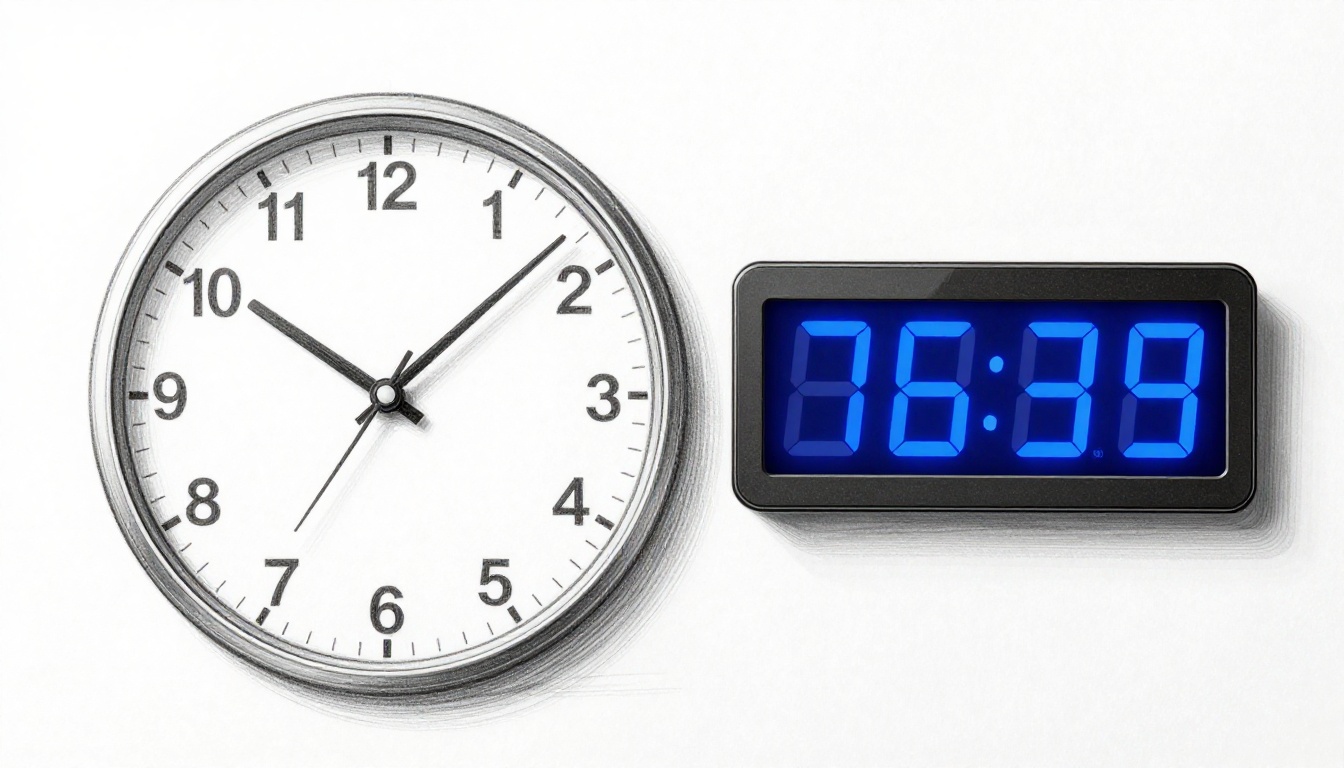
You check the time in the morning, and you decide fast. A wall clock with moving hands gives one kind of read. A phone screen at night gives another.
The difference between analog and digital clocks comes down to how time appears and how you interpret it. Analog clocks show time with hands on a round face. Digital clocks show time as numbers on a screen.
This guide explains how each type works, where each one fits best, and what trade-offs matter in real life. You will also get practical tips for choosing a clock that matches your space and routine.
How Analog Clocks Work with Hands and Dials
Analog clocks use a simple, visual system. The time display relies on moving hands and a numbered dial, usually marked 1 through 12. In common household use, three parts may appear: the hour hand, the minute hand, and sometimes a thin second hand.
The hour hand is shorter, and it moves slowly. The minute hand is longer, and it moves much faster. The second hand, if present, is usually the thinnest and fastest. As a result, analog time feels continuous. You can watch it progress, even when you do not need exact seconds.
Most analog clocks show time on a 12-hour circular face. Numbers around the edge act like anchors. Therefore, reading them becomes a matter of position, not counting digits.
If you need a quick refresher on the parts and basics, see what an analog clock is for a simple breakdown.
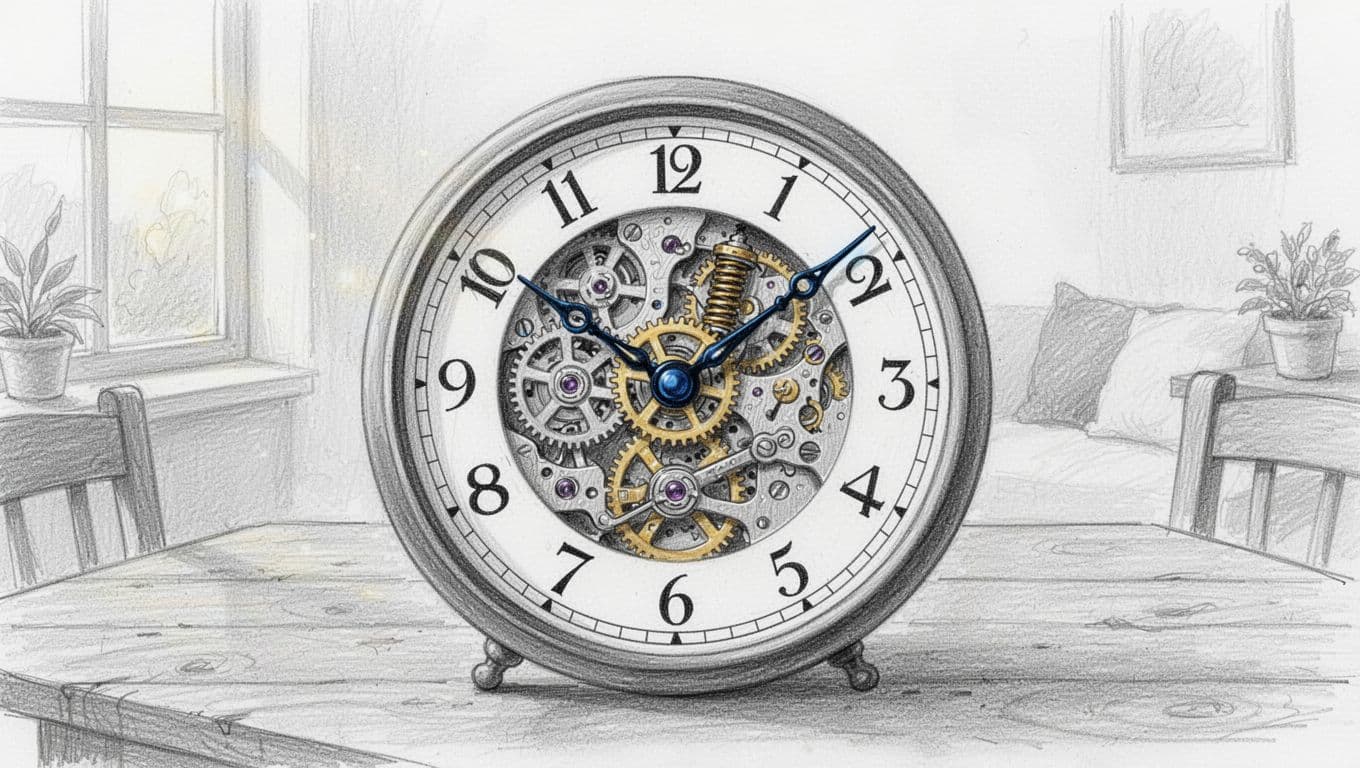
From a mechanism view, analog clocks fall into two main categories. First, mechanical analog clocks use springs and gears. A key wind or a weight provides the energy. Next, many analog clocks are quartz-based. In those, a battery powers a motor that moves the hands.
Historically, analog clocks go back centuries. In earlier timekeeping, people used sun shadows and designs that behaved like a sundial. Over time, gears replaced shadows, and springs replaced muscle. Still, the core idea stayed the same. Time moves across a face you can see.
Mechanical vs Battery-Powered Analog Clocks
Analog clocks can look similar from the outside. However, the internal power system differs. That difference affects maintenance needs, accuracy over time, and the feel of the ticking.
Mechanical analog clocks rely on stored energy. A spring and gear train release that energy in steps. When the clock runs, the hands move because the mechanism transfers energy through gears. If the clock needs winding, owners must wind it on a schedule. Some styles use a key, others use a weight and pendulum-style motion.
Battery-powered analog clocks, often called quartz analog clocks, use a different approach. Quartz analog clocks use electronics plus a small motor. The motor moves the hands at a steady rate. Because the timing comes from a quartz oscillator, the clock usually requires less owner work.
If you want a direct comparison between those two analog types, this guide on mechanical vs. quartz clocks provides a clear side-by-side view.
Ever heard the tick-tock? Mechanical clocks often produce a more noticeable sound. Some people like that sound, because it makes time feel present. Quartz clocks may still “tick,” but many models feel quieter.
Battery use also matters. Quartz analog clocks commonly run for months or longer on a single battery. Still, a battery will not last forever. The owner must replace it eventually.
Accuracy is another practical point. Quartz analog clocks tend to hold time better than many mechanical units. Mechanical clocks can drift more, especially if a clock stops, gets bumped, or runs in changing temperatures.
So, the choice comes down to what you value most. Do you want fewer tasks, or do you want a hands-on mechanical experience? Both options serve real needs.
Reading Time on an Analog Face
Reading an analog clock depends on interpreting angles, not numbers on a screen. Still, the skill stays simple once you practice.
Start with the hour hand. Next, use the minute hand to find the exact minute mark. In many everyday cases, you can read time in “fractions” instead of exact counts.
For example, when the minute hand points straight up at 12, the time is exactly on the hour. When the minute hand points to 3, the time is “quarter past.” When it points to 6, the time is “half past.”
Therefore, common phrases work well:
- Quarter past: minute hand on 3
- Half past: minute hand on 6
- Quarter to: minute hand near 9, because the next hour is coming
A strong benefit appears when you want time intervals. Analog clocks show how close you are to the next hour. As a result, people often use them to estimate time left. You can glance and say, “It’s about ten minutes until lunch.”
The second hand adds another layer. When the second hand moves continuously, you can monitor precision. That helps in situations like timing a short break. Yet, for daily planning, most people rely on hour and minute hands.
Also, analog clocks can help kids learn time. Kids often struggle with number-only time displays. An analog face turns time into a visible pattern. It teaches that time moves in steps, and it shows past and near future at once.
In short, analog clocks do not just tell time. They also train your eyes to understand time distance. That capability matters in busy homes and busy classrooms.
Digital Clocks: The Quick Numeric Display
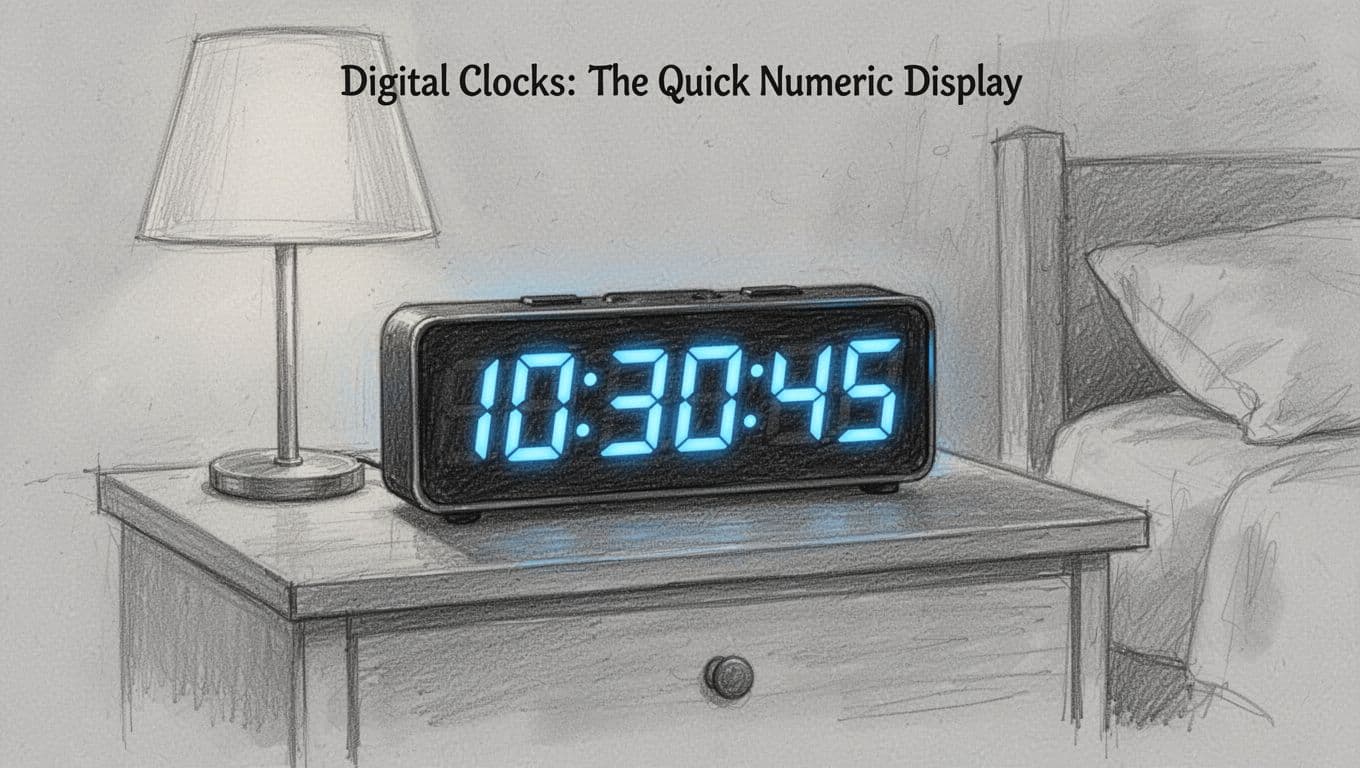
Digital clocks show time as numbers on a screen. Instead of hands and a dial, the display uses segments or pixels that light up. As a result, digital clocks give an instant answer. You do not interpret angles. You read the digits.
Many digital clocks use quartz timing inside. A quartz crystal vibrates at a precise rate. The clock electronics count those pulses and convert them into hours, minutes, and seconds. Then the display lights up the time in a visible format.
Most digital clocks support either 12-hour format with AM/PM or a 24-hour format. That choice affects how quickly some people read the time. However, the core advantage stays the same. The display gives exact time values right away.
A practical set of examples includes alarm clocks, microwave displays, and phones. People often prefer digital clocks in rooms where fast reading matters. A kitchen may need a quick “start now” signal. A bedroom may need a clear wake-up time.
Compared to analog, digital clocks also handle bright visibility in low light with ease. Backlights and glowing digits work well. As a result, the clock read stays clear in dark rooms.
For a plain-language explanation of quartz clock timing, this resource on how quartz clocks work is helpful. It explains the basic idea without turning it into a physics exam.
Digital clocks do have trade-offs. Power use often rises when displays add backlights. In addition, some digital clocks rely on batteries and require replacement. So, the owner manages batteries in the same way as with analog quartz.
Another trade-off is interpretation. Digital clocks do not show time passing across a face. They show “now,” not the path of the next hour. Still, for many routines, “now” is exactly what people need.
Inside the Quartz Tech That Powers Them
Digital clocks need stable timing. Therefore, many of them use a quartz oscillator inside.
Quartz crystals behave like a timing system with a repeatable vibration. When power flows to the circuit, the crystal vibrates at a fixed frequency. In many common designs, that frequency lands around 32,768 times per second. Then electronics divide the vibration down to match seconds, minutes, and hours.
Because the circuit counts those timing pulses, the clock tends to keep time more steadily than many mechanical designs. Also, the motor that moves hands in analog quartz units uses the same timing source. So, quartz-based clocks often share a similar stability goal.
High-end systems sometimes sync to more accurate references. For example, some specialty clocks use radio signals linked to atomic time standards. In those setups, the clock can correct drift. Most everyday household digital clocks do not do this, but the option exists.
A useful analogy is a tuning fork. A tuning fork sets a steady pitch. The clock uses that steady “pulse” to build seconds and minutes. Then the display shows the result as numbers.
As a result, digital accuracy often stays strong for normal use. However, accuracy still depends on power stability, temperature, and component quality. So, a cheap clock may drift more over months.
In addition, some digital clocks skip seconds display or update less often. Those designs can still show correct time, but the user might notice fewer updates. Still, the time display stays crisp and readable.
Advantages in Low Light and Extra Features
Digital clocks commonly win on “read it instantly” tasks. The reason is direct display. Numbers light up, and the meaning does not depend on angles.
In low light, digital clocks often add features. Backlights can turn a dim room into a readable setting. Some models also offer “auto dimming.” So, the clock stays visible without shining harsh light.
As for added functions, digital clocks frequently support multiple tools in one unit. Common add-ons include:
- Alarms for wake-up or reminders
- Timers for quick tasks
- Calendars on some devices
- Temperature readouts
- World time settings on travel-friendly clocks
For bedroom use, that combination can replace multiple gadgets. A bedside digital clock can handle wake-up, quick countdown, and a visible time check. As a result, users reduce phone screen checks.
However, battery life can drop faster if features stay active all day. Backlights and extra sensors use power. Also, frequent button presses do not help battery drain, but the display and electronics do.
So, the compliance-style bottom line is simple. Digital clocks trade a bit of power for speed and visibility. If you value instant reading and built-in functions, digital fits well.
Head-to-Head Comparison: Which Wins and Why
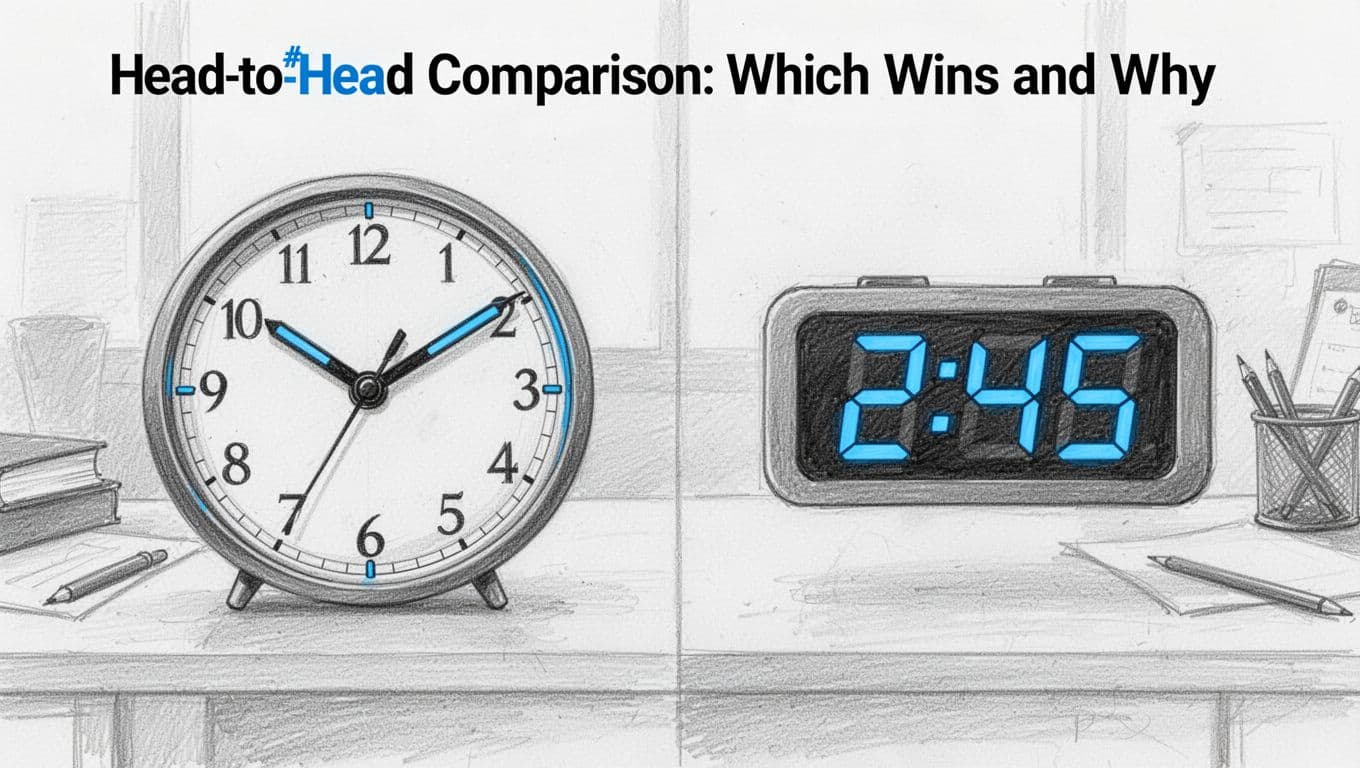
A direct comparison depends on what you consider “winning.” If “winning” means exact time at a glance, digital usually leads. If “winning” means time that feels visible and continuous, analog usually leads.
Accuracy often favors digital clocks. Quartz timing makes it easier to keep seconds steady. In contrast, mechanical analog clocks can drift. Quartz analog clocks can reduce drift, but the read method still differs.
Read speed typically favors digital. You see numbers. Therefore, you do not interpret angles. If you stand in front of a screen, you get the exact minute quickly.
Battery life tends to lean toward analog quartz in simple setups. Many analog quartz clocks can run for months. Digital clocks can run just as long in some cases, but backlights and extra features increase power use.
Features often favor digital clocks. Digital devices can show alarms, timers, calendars, and other data. Analog clocks focus on time display and style. That focus can be a benefit, because fewer functions means fewer things that break.
Low light visibility often favors digital. Backlit digits stay readable when hands and dial markings fade.
Learning time can favor analog. Analog teach “quarter past” and “quarter to” in a visual way. Digital teaches exact time values. Most families use both in daily learning.
If you want a more narrative take on how each type frames the same seconds, see Analog vs. Digital Telling Time for a higher-level discussion.
Modern homes often use a mix. A person might keep a wall analog clock for the living room. Then they use a digital alarm clock in the bedroom. That arrangement matches real routines.
Also, in March 2026, US market interest has shifted toward analog clocks and watches in more spaces. Hybrid clocks with classic faces and extra smart features have also gained attention. Fully digital clocks still exist, but the “hands-on” look often draws more buyers than before.
Accuracy, Speed, and Battery Life Breakdown
Accuracy breaks down as follows. Digital clocks often use quartz timing with stable internal counting. Therefore, they tend to show consistent time. Analog mechanical clocks may lose time faster if they drift. Analog quartz clocks tend to improve that issue.
Speed breaks down as a reading habit. Digital wins at “what time is it” checks. You read digits. In contrast, analog requires interpretation. You still can read analog fast, but you rely on training and practice.
Battery life depends on design. Analog quartz clocks often use a small motor to move hands. They may also use less power on a plain dial. Digital clocks with screens and backlights use more energy. So, digital battery life can vary more by feature set.
In real scenarios, this difference shows quickly. In a sports timer use case, digital starts and ends clearly. In an office, an analog wall clock may support “at a glance” flow during meetings.
Meanwhile, analog can support room rhythm. The hands keep moving, and you can feel how much time remains. Digital can still feel rhythmic with seconds updating. However, the numeric read often pulls attention toward “exact now.”
Best for Learning Time and Daily Life
Learning time often needs both display styles. Analog clocks help with intervals. Students see how the minute hand moves toward the next hour. That visual helps kids grasp “quarter to” and “half past” as real time blocks.
Digital clocks help with exactness. Students learn to match digits to events. They also learn AM and PM. For homework routines, digital can reduce confusion.
Daily life often follows the same rule. People plan with intervals at home. They check exact times at appointments.
In addition, many people now use hybrids. Hybrid clocks use an analog face for “feel,” then add digital data like a date. Some clocks also include alarms, so the screen supports function without fully taking over attention.
As of March 2026, this hybrid approach appears popular because it blends the two strengths. The result is a familiar look with practical upgrades.
So the recommended position is not “one wins forever.” Instead, use the clock type that matches the task. Then use the other type for the remaining tasks.
Choosing the Right Clock for Your Needs Today
Clock choice works best when you define the purpose first. A clock that serves decoration should not fail because you want alarms. A clock that supports wake-ups should not hide in low light.
Analog clocks fit best when you need a visible sense of time passing. They also fit if you want a room look that feels classic and calm. In addition, analog works well for teaching time intervals to kids.
Digital clocks fit best when you need quick accuracy. They also fit for dark bedrooms, kitchens, and spaces with alarms and timers. Digital clocks keep time values clear without angle reading.
In practice, many households add more than one clock. One analog clock can anchor the living space. One digital clock can handle wake-ups and timers. This mix also supports common routines without extra steps.
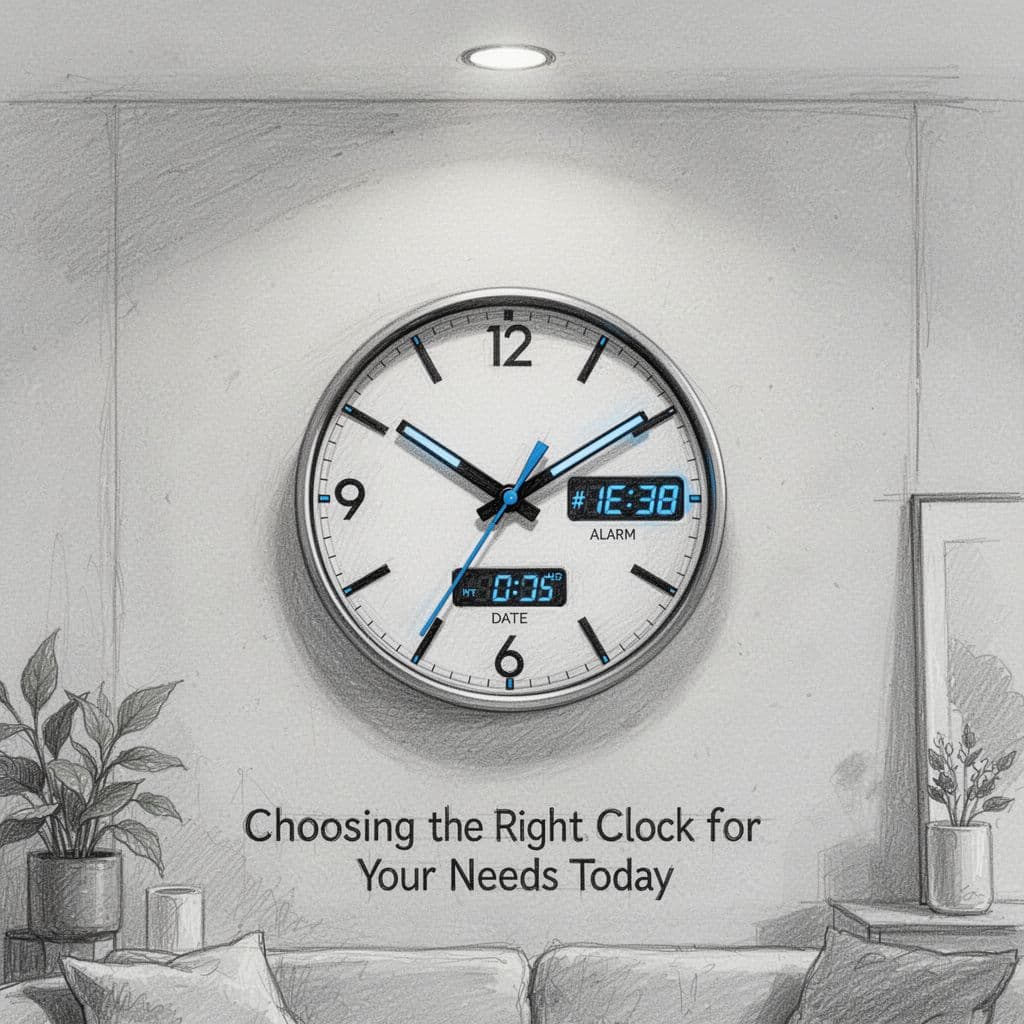
Hybrid clocks can reduce that number even more. A hybrid provides an analog face and adds digital functions like date and alarm support. If you want one device to cover both reading styles, hybrid offers that option.
For an additional buying-oriented perspective on how to choose between options, see comparing analog and digital clocks.
Finally, confirm the placement. If you will place the clock across the room, choose based on readability. If you will place it beside a bed, choose based on low light visibility. Also, consider battery replacement access. That detail becomes important when the clock runs daily.
Conclusion
The analog and digital difference is not just style. It comes down to how time shows up, how fast you read it, and what trade-offs you accept.
Analog clocks provide a continuous visual flow through hands and a dial. Digital clocks provide instant numeric clarity through screens and quartz timing. Both types can support real life, depending on whether you need intervals, exact now, or extra features.
If you want a simple next step, check the clocks you already use. Then choose a replacement that matches the job, not only the look. In other words, let your routine decide, because timekeeping works best when it fits your day.