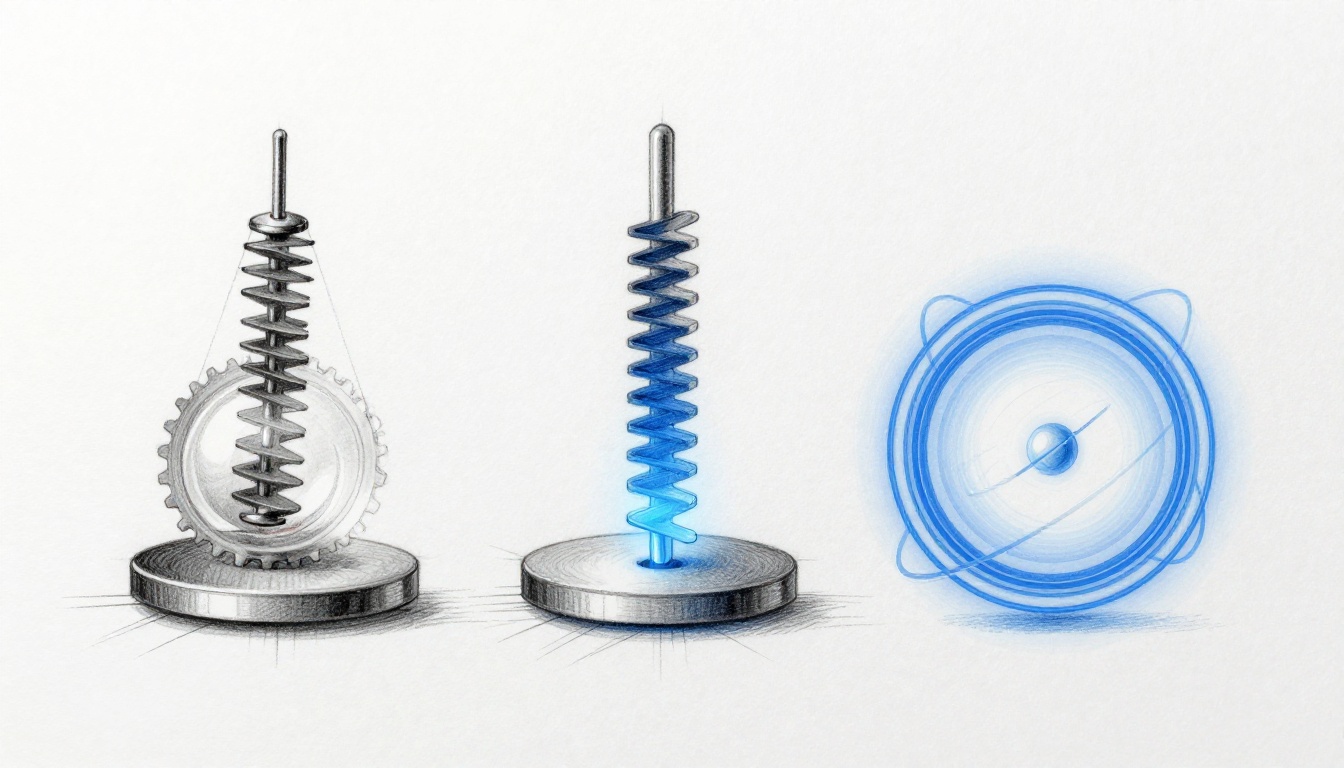
Ever check your phone, then look at your watch and think, “How is it that close?” Clocks keep time accurately because they rely on a steady rhythm, like a heartbeat that repeats again and again. When that rhythm stays consistent, seconds line up in a way you can trust.
Different clocks use different “heartbeats.” Some use pendulums and gears. Others use quartz crystals. The most precise use atoms.
Next, you’ll see how how clocks keep time accurately starts with counting repeatable motion, and how today’s best clocks fight the real world’s annoyances like heat, wear, and signal drift.
Why Every Clock Needs a Reliable Beat
A clock is basically a counter with a job: it measures time by counting repeated motion. If that motion repeats the same way each cycle, the clock can translate cycles into seconds.
In mechanical clocks, the repeated motion might be a swinging pendulum. In watches, it could be a vibrating balance wheel. In quartz clocks, it’s a vibrating crystal. In atomic clocks, it’s how atoms respond to light and microwaves.
The key idea is consistency. Think of it like counting footsteps. If every step lands in the same spot, your total distance stays accurate. If your steps get longer when you’re warm, the math falls apart.
That’s why timekeeping systems include two parts:
- A beat generator (pendulum, quartz, atoms)
- A gear or signal system that turns those beats into ticks and seconds
Mechanical clocks add one more piece that matters a lot. They use an escapement, which “releases” energy in small, controlled amounts. That keeps the beat smooth instead of surging and slowing.
Historically, this approach took time to mature. Once mechanical clocks became common in European cities in the late 1200s and 1300s, engineers focused on making the beat steady enough for daily life. For more background on how timekeeping methods changed, see NIST’s walkthrough of timekeeping history.
Even then, errors creep in. Temperature can change metal size. Lubricants dry out. Dust can slow a moving part. Then the beat changes slightly, and the clock gains or loses time.
So the real question becomes simple: how do you keep the clock’s beat steady when the environment refuses to stay still?
From Pendulums to Vibrations: The Evolution of Clock Hearts
Clock makers didn’t jump straight to atoms. They improved one “heartbeat” at a time. Each new design made the beat more repeatable, and it reduced the ways the beat could drift.
Pendulum clocks became famous because a pendulum has a strong rhythm. If you gently disturb it, it tends to swing back with a predictable pattern. That helped people build clocks that were far steadier than early gear-only designs.
Later, watches needed something smaller. A pendulum won’t fit in a pocket. So designers used a balance wheel with a spring. It acts like a tiny oscillating pendulum inside a watch.
Then quartz arrived. Instead of relying on metal swinging, quartz uses the crystal’s ability to vibrate when electricity passes through it. That vibration repeats fast and evenly.
After that, atomic clocks went even deeper. They don’t count a mechanical swing at all. They count an atom’s response to carefully tuned energy.
In the long arc, timekeeping also pushed into new materials and micro devices. One helpful history of that shift is SiTime’s look from pendulum clocks to MEMS oscillators.
And along the way, scientists helped explain why clocks drift. Galileo’s work in the 1600s on motion and time helped set the stage for pendulum thinking. Over time, better physics plus better manufacturing turned “sort of accurate” into “trustworthy.”
Mechanical Clocks: Swings and Gears That Shaped History
Mechanical clocks can look simple on the outside. You see a face, hands, and maybe a pendulum. But inside, they are carefully tuned systems that turn repeating motion into steady ticks.
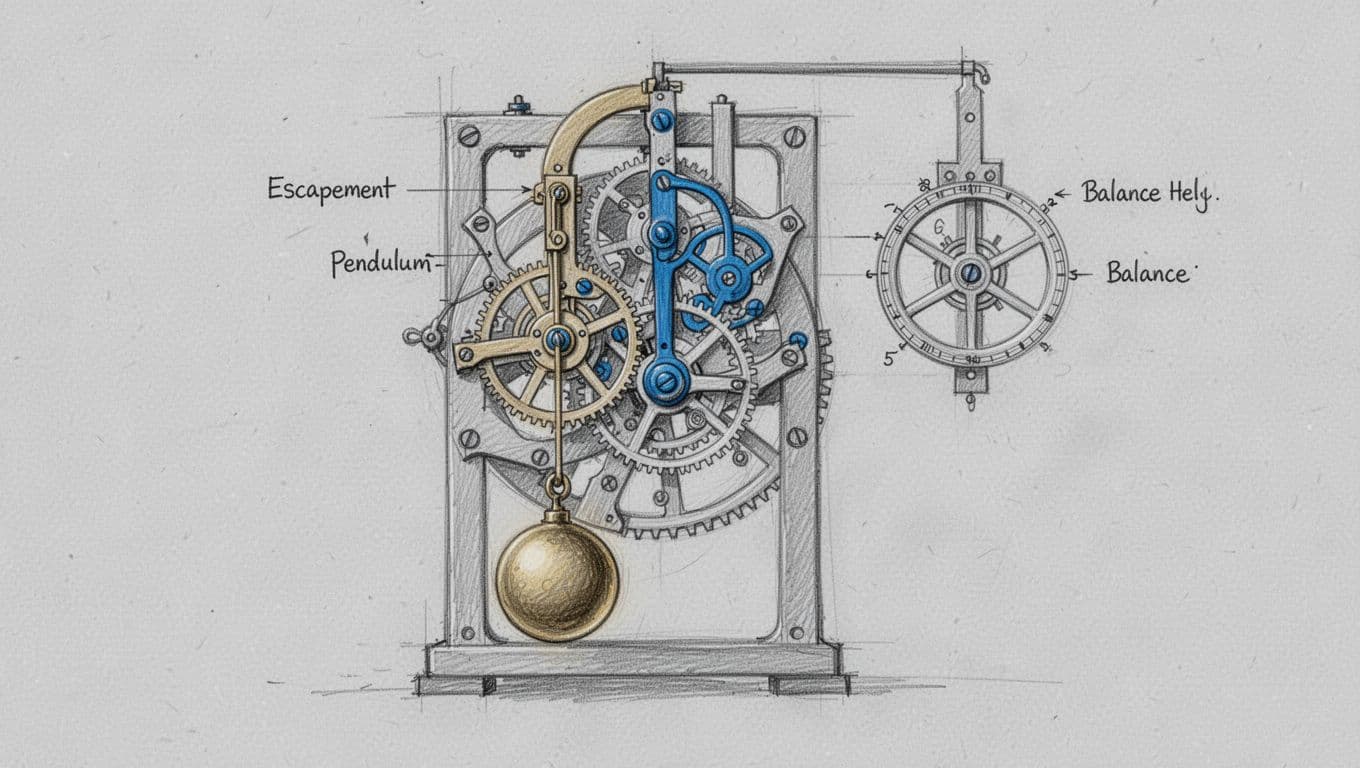
For many classic clocks, the pendulum sets the pace. Its length influences the swing period. Then the escapement links that swing to the gear train. That gear train moves the hands one step at a time.
A typical mechanical setup includes:
- Power source: a wound spring or a hanging weight
- Gear train: a set of gears that transfer motion
- Escapement: the controller for each tick
- Regulator beat: pendulum or balance wheel
Precision depends on repeatability. If the pendulum swings a little faster today than it did yesterday, the clock gains time. If it slows down, the clock loses time.
However, mechanical accuracy is never only about the pendulum. It also depends on what happens to the metal over time. Heat changes how fast parts move, and friction changes the energy flow. Even small dirt particles can affect the escapement.
If you want the “science behind the swing,” this guide on how pendulum clocks keep time explains how the escapement and power transfer interact.
Some mechanical clocks can stay off by only a few seconds per day, especially well-made ones. That’s impressive for a device with no battery and no electronics.
Still, if you need accuracy across months, mechanical clocks have limits. Temperature swings and long-term wear become the enemy. That’s where clockmakers got very inventive.
Taming Temperature Swings for Better Daily Accuracy
Heat and cold push mechanical clocks off pace. The pendulum changes shape as metal expands or contracts. Friction also changes with lubrication and viscosity.
Clock makers responded by changing materials and geometry. One approach was to design pendulums with compensation rods that counteract expansion. Another approach was to change how the pendulum’s length effectively behaves as temperature shifts.
Marine timekeeping pushed this problem hard. Ships needed accurate time to find longitude at sea. That is where inventors like John Harrison earned their reputation. His marine chronometers used careful engineering to keep their timing closer to stable as conditions changed.
Here’s a simple way to picture it. Imagine your pendulum is like a playground swing. If the swing’s rope gets slightly longer in summer, it takes more time per swing. So the clock counts fewer swings in a fixed time window, and it loses time.
Even homes can create cycles. If your clock sits in a sunlit room, the temperature near the movement may run warmer than the room average. As a result, you see seasonal drift.
To reduce that, some people keep a mechanical clock in a stable room. Others choose quartz for daily reliability.
Still, it’s worth appreciating the ingenuity. Mechanical clock accuracy came from fighting physics with design.
Quartz Clocks: Tiny Crystals Powering Your Everyday Watch
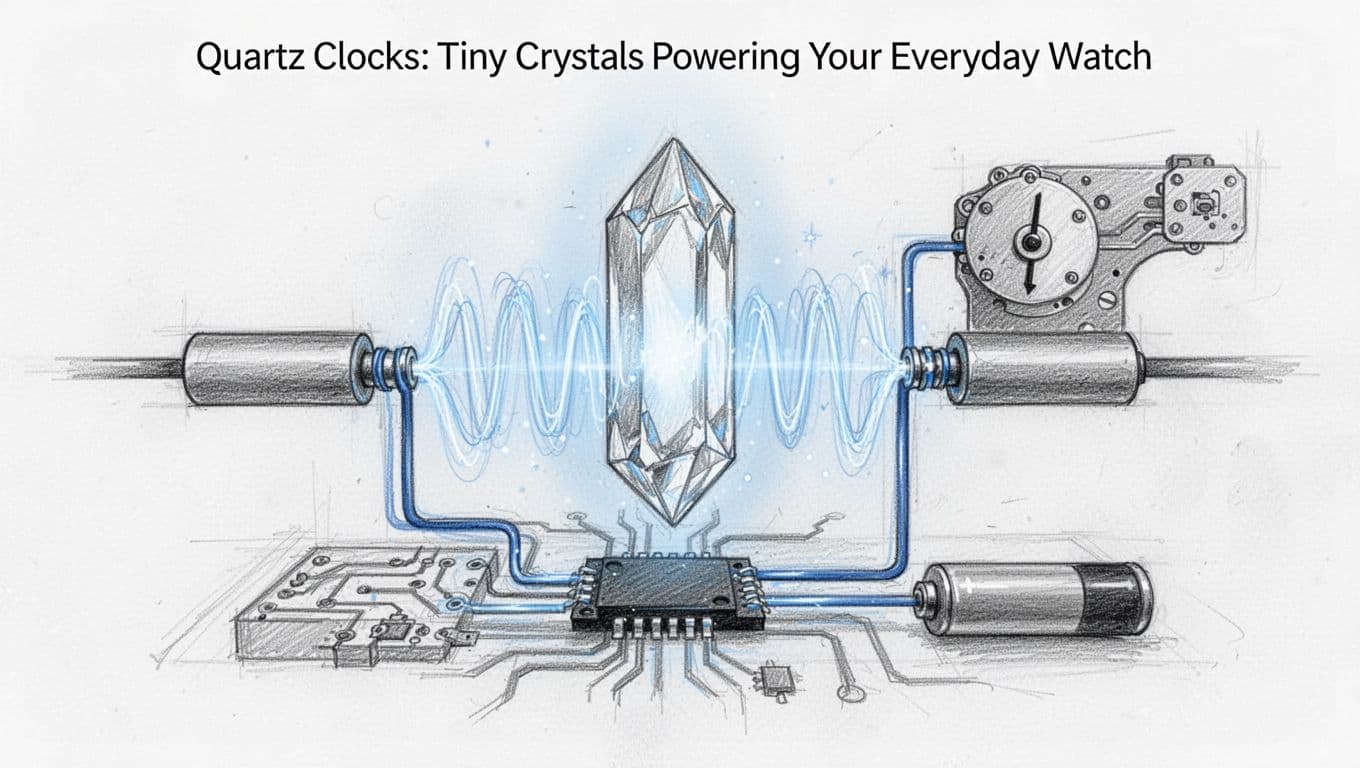
Quartz clocks use a different kind of “beat.” Instead of relying on a swinging piece of metal, they rely on a quartz crystal’s vibration.
When you apply an electrical signal, the crystal vibrates at a steady frequency. That vibration is then converted into a regular signal for the rest of the clock.
Many common quartz timepieces use a frequency of 32,768 Hz. That number matters because it’s easy to divide down. In basic terms, the electronics take the fast vibration and step it down until it becomes 1 pulse per second. That pulse moves the seconds indicator, or helps generate digital time.
Compared to older mechanical systems, quartz has an advantage. The vibration is very repeatable. Also, the clock doesn’t depend on a delicate escapement sliding against metal parts all day.
Quartz clocks still make mistakes, though. Temperature changes can slightly shift the crystal’s vibration rate. Over long time, aging can also affect performance. Typically, these effects are small enough that you notice them only after weeks or months, not minutes.
For day-to-day wear, quartz is a sweet spot. It’s cheap, reliable, and consistent.
Some larger clocks use household power too. For example, many wall clocks get timing from the alternating current (AC) frequency in the power grid. That’s convenient, but accuracy depends on the stability of the grid and the clock’s design.
Still, when you want “accurate enough” with minimal fuss, quartz tends to win.
Why 32,768 Hertz Became the Magic Number
The number 32,768 is 2 to the 15th power. That’s why it became so popular in quartz timing circuits.
When you can divide by 2 repeatedly, you can build simple digital circuits that step down the frequency with less complexity. You get a clean 1 Hz signal, then count those pulses to display seconds, minutes, and hours.
In other words, quartz clocks don’t just need a fast heartbeat. They also need a practical way to convert that heartbeat into human time.
If you want a deeper look at how the 32.768 kHz oscillator fits into modern electronics, see 32.768 kHz crystal oscillator basics.
This is also why many electronics outside watches rely on crystal timing. Real devices need stable timing for clocks, sensors, and communication.
So the next time your watch stays close over a long day, you can thank one quiet crystal doing its steady job.
Atomic Clocks: Atoms Ticking in Perfect Sync Worldwide
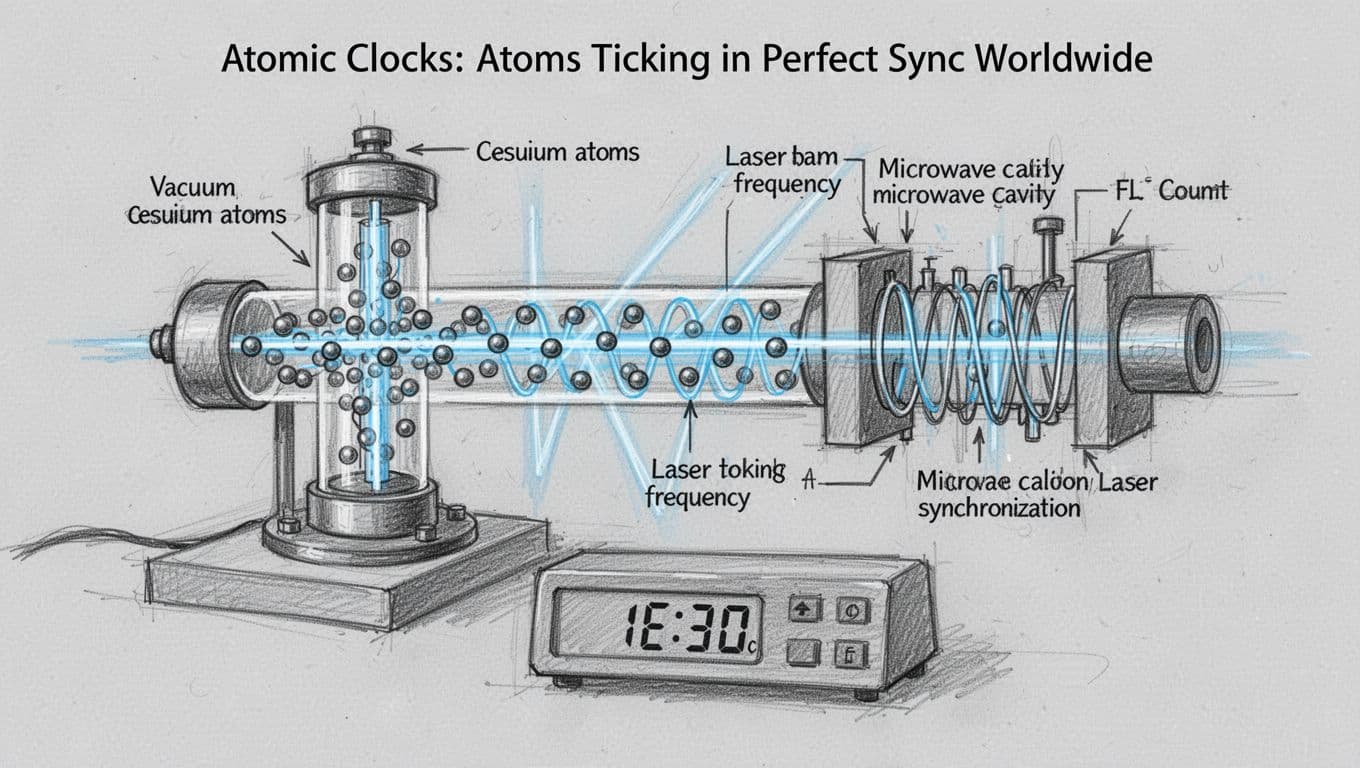
Atomic clocks take “repeatable beat” to a new level. They don’t count pendulum swings or crystal vibrations. Instead, they measure a transition frequency tied to atoms, like cesium.
In a cesium fountain atomic clock, scientists use microwave signals and laser cooling. They trap or launch atoms in a way that helps them interact with the microwave field. Then the clock locks onto the frequency that matches the atom’s energy change.
This is why atomic clocks are so strong for precision. The frequency comes from nature, not from a piece of metal under varying conditions.
NIST describes cesium fountain atomic clocks and how they realize time and frequency.
In terms of performance, atomic clocks can be accurate to about a second over extremely long spans of time. The electronics around the atoms still drift, but scientists can correct that drift by re-locking the signal.
There’s also a hidden challenge: atomic systems need careful control. Temperature, magnetic fields, and even some forms of noise can affect the measurement. That’s why atomic clocks often sit in controlled labs with shielding and stable power.
Once you have very accurate time, you can distribute it. Many services rely on network time servers and GPS signals. Atomic clocks don’t just sit quietly. They make modern timing systems work.
How They Sync Global Time and Satellites
Your phone doesn’t hold an atomic clock in your pocket. Instead, it syncs from systems built on atomic references.
GPS timing shows why this matters. Satellites need extremely accurate time to compute position. The receiver measures signal travel time, then turns it into distance. If time is off by even a tiny amount, the position estimate shifts.
The Smithsonian’s synchronized accurate time explains how GPS needs precise clocks for accuracy.
Atomic clocks also connect to UTC, the global time standard. UTC is maintained through worldwide coordination, with adjustments like leap seconds when Earth’s rotation changes enough. Those changes remind us that atomic time is stable, while Earth’s spin is not perfectly smooth.
So atomic clocks keep global time accurate by acting as the reference point. Everything else counts down from that point.
2026 Breakthroughs: Optical Clocks and Pocket-Sized Precision
As of March 2026, researchers continue pushing past cesium. A major theme is optical clocks, which use light frequencies and trapped atoms.
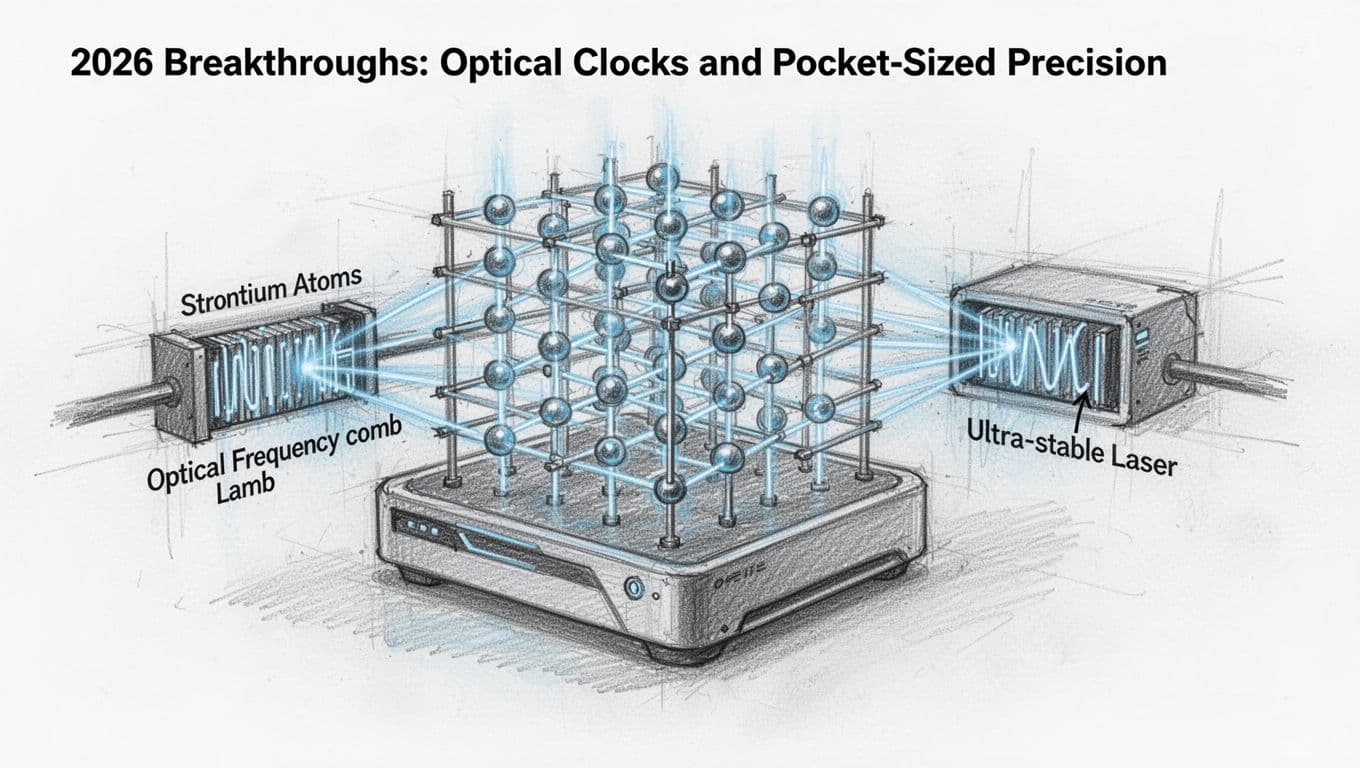
Recent reports point to a strontium optical lattice clock built by researchers at the University of Science and Technology of China. It’s described as about 100 times more accurate than the cesium atomic clocks that define the second today. The claim is striking: it would lose or gain about one second over 30 billion years.
Optical lattice clocks work by trapping atoms in a grid made with laser light. Then they measure an atomic transition using ultra-stable lasers. Because light has a much higher frequency than microwaves, these clocks can reach extreme precision.
The idea of redefining the second also keeps moving. International timing bodies aim to reframe the definition around newer, more accurate standards. Reaching that goal by around 2030 depends on agreement among multiple top clocks.
Meanwhile, engineers are making clock tech smaller. One trend is chip-scale atomic timing meant for more real-world uses. That could improve GPS performance and enable better timing in devices that cannot fit a full lab system.
For context on where NIST is heading with smaller atomic clocks, see NIST chip-scale clocks.
What These Advances Mean for Your Gadgets Soon
Even if you never touch an atomic device, the payoff shows up in daily systems.
Better optical clocks could mean improved navigation accuracy. In turn, that can help advanced mapping, timing for telecom networks, and more reliable positioning in difficult areas.
Chip-scale atomic clocks also matter for practicality. Smaller atomic references can fit into setups that need steady timing but cannot run a full lab.
So the “tick” you hear from a phone clock or car dashboard isn’t magic. It’s the result of people building a beat strong enough to survive weather, movement, and noise.
Conclusion
Clocks keep time accurately because they count a repeating rhythm, then protect that rhythm from the real world. Pendulums, quartz crystals, and atoms all serve the same mission: a stable beat that repeats without wandering.
Mechanical clocks show what careful engineering can do. Quartz clocks show how vibrations can stay steady in daily life. Atomic clocks show what happens when timing is tied directly to nature’s own frequency.
Now optical clocks and smaller atomic references are pushing the next wave. The next time your watch stays on, remember the quiet work behind every accurate second. What kind of clock do you trust most, your phone, a wall clock, or a timepiece you wear?