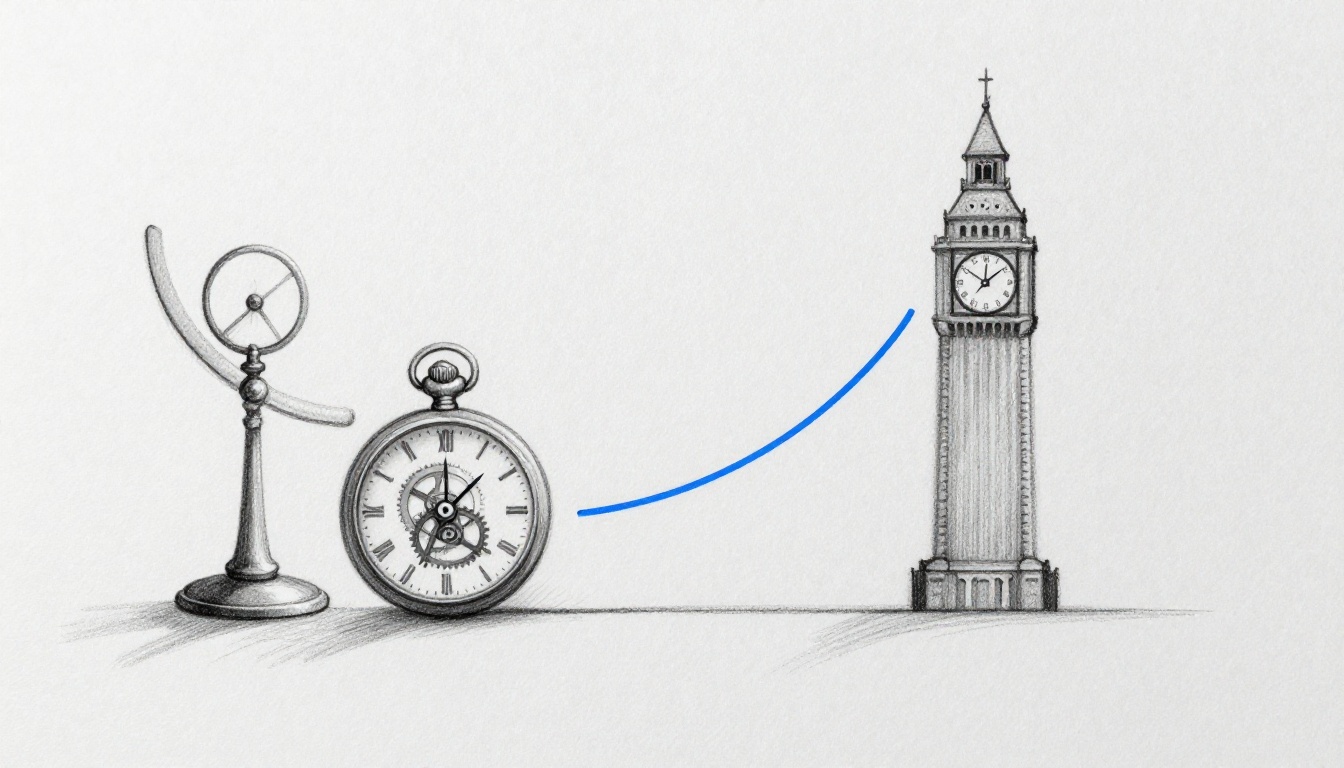
Have you ever shown up late because your phone “should’ve” synced? Or rushed to make a meeting before a deadline, then realized your schedule was off? Those moments feel small, but they happen because timekeeping is how we coordinate real life.
Timekeeping means measuring and tracking time using tools, signals, and agreed rules. Sometimes it starts with nature, like the sun. Other times it uses machines, like clocks and atomic standards. Either way, it turns time into something people can share.
From ancient shadows on a wall to today’s GPS signals, timekeeping shapes how we plan, work, learn, and travel. It also drives scientific discoveries because experiments need stable timing. And when timing breaks down, the effects can spread fast.
In this guide, you’ll see where timekeeping came from, how modern clocks keep time, and why accurate timing matters in daily life, business, science, and navigation. You’ll also get a look at what’s coming next in March 2026.
From Shadows on the Sand to Swinging Pendulums: A Brief History of Timekeeping
Long before wrists and satellites, people still needed order. They needed to know when the sun would set, when animals would feed, and when work should start. Early timekeeping answered that need by linking time to visible changes in the sky.
One of the oldest tools was the sundial. It used a stick (or gnomon) that cast a shadow. As the sun moved, the shadow shifted. That shift marked parts of the day. Sundials were simple, but they only worked well when the sun was out.
For night hours, people used other methods. A water clock measured time by tracking water flow. Often, water dripped at a steady pace into a container. As the water level rose, it counted time. Candle clocks and hourglasses also helped for shorter stretches, like timing tasks or prayers.
By the 13th century, mechanical clocks appeared in Europe, often in church settings. These clocks used gears and weights. They could run through day and night, so the idea of time became more consistent. In many places, time then started to follow fixed hourly structure, not just sunrise and sunset.
Then came the push for accuracy. Christiaan Huygens built a pendulum clock in 1656. A pendulum swings at a steady rhythm. That steadiness improved time measurement, especially for seconds.
The modern era brought faster tuning. Electric clocks spread in the 1800s, then quartz clocks arrived in the 1900s. Quartz watches vibrate at a stable rate when electricity powers a crystal. As a result, they became common and affordable.
In 1955, atomic clocks helped set a new standard. They measure time using the behavior of atoms, such as cesium. Because atomic transitions happen at extremely steady frequencies, these clocks can keep time far better than mechanical or quartz designs. Today, timekeeping still follows that same idea: track a stable process, then translate it into shared time for everyone.
If you want a deeper timeline, Scientific American covers how early cultures built tools like sundials and water clocks, then how technology improved over time in Timekeeping Has a Long, Colorful History. You can also see a shorter overview in The History of Timekeeping | M.S. Rau.
Ancient Tools That Started It All
Sundials, water clocks, candles, and hourglasses all shared one goal: turning a vague feeling of “later” into something countable. For sundials, the sky did the work. For water clocks, gravity and flow did.
However, each tool had limits. A sundial depends on sunlight. Clouds can ruin it. A water clock depends on a steady drip, and that means the container and flow must stay consistent. Hourglasses are great for short intervals, but they run out quickly. Still, these devices shaped daily habits. In many communities, timing helped people coordinate prayer, meals, and work shifts.
There’s also a social side. When a society agrees on time markers, people start organizing around the same signals. That shared rhythm makes cooperation easier, even across generations.
Breakthroughs That Changed Everything
Mechanical clocks made time less dependent on the weather. Pendulum clocks increased accuracy, especially for short units like seconds. Then electricity and quartz reduced drift, so clocks stayed closer to “true time” for longer periods.
After that, atomic timekeeping changed the game. Atomic clocks don’t “tick” like a pendulum. Instead, they count extremely regular events in atoms. That method strengthened the definition of the second, so it could be repeated anywhere.
This mattered for everyday life too. When time standards become dependable, calendars and schedules become easier to run. Trains, calls, broadcasts, and international meetings benefit from time that doesn’t wander.
It also helped science. Astronomy, particle experiments, and precision measurements all need consistent timing. In plain terms, timekeeping became a lab instrument, not just a household tool.
How We Tell Time Today: From Wristwatches to Atomic Precision
Modern timekeeping works like a chain. Each link tries to stay stable, then passes that stability along. Your wristwatch gets time from a crystal oscillator. Your phone often gets time from network signals. Behind those signals, atomic clocks keep the timing reference steady.
A quartz watch is a good example of everyday precision. It uses a vibrating quartz crystal. That vibration acts like a metronome. Because quartz oscillation stays consistent, quartz watches can keep accurate time for months.
Smartphones and smartwatches usually rely on network timing. Most people notice this as “set automatically.” When you turn on updates or connect to a carrier network, your device syncs the time. That sync helps your reminders, timestamps, and alarms line up across apps.
If you want a clearer comparison of clock types and how accuracy changes, this guide explains the tradeoffs across Quartz, Mechanical, Atomic and Smartwatches.
Here’s a quick view of how today’s timekeepers compare:
| Timekeeping type | Time source | Common use |
|---|---|---|
| Quartz watches | Crystal vibrations | Daily personal timing |
| Smart devices | Network time sync | Schedules and phone logs |
| GPS timing | Satellite signals | Location and navigation |
| Atomic standards | Atom frequency reference | Global time authority |
The most precise clocks still come from atomic standards. In particular, optical atomic clocks are getting attention. According to recent reporting, a strontium optical clock can keep time so well that it would lose or gain about one second over roughly 30 billion years. Researchers have also worked on a cryogenic single-ion trap approach, aiming for much higher accuracy than earlier designs.
Atomic timekeeping also powers navigation. GPS receivers use timing signals to compute distance. If the timing is off, the position math won’t land correctly.
Your Pocket Timekeepers: Smartphones and Watches
If you wear a watch, you probably trust it without thinking. That trust comes from two ideas: stable oscillation and routine updates.
Quartz watches do the stable part. Smartwatches and phones do the maintenance part. They sync time through networks or other signals. Many devices also adjust automatically when you travel, which keeps your calendar events aligned.
Another detail matters too: stability against magnetic fields and temperature swings. Some watch designs handle these issues better than others. Over time, those engineering choices affect how consistently a watch keeps time.
Why Timekeeping Keeps the World Running Smoothly
Timekeeping isn’t only about neat schedules. It’s about coordination at scale. When many people act at the same time, timing mistakes create friction. They can also cause real costs.
Think about your day. You might wake up at a certain time, drive to work, start a shift, and eat lunch at scheduled intervals. These steps feel routine because timekeeping makes them predictable. Without it, “after work” becomes unclear. “Right after lunch” becomes a guess.
Now scale that up.
Businesses run on shared timing. Meetings, shifts, deadlines, and deliveries depend on a common clock. When global teams collaborate, they coordinate across time zones. That only works when everyone agrees on the same time rules.
Science also depends on accuracy. Experiments compare results taken at the same reference conditions. If timing drifts, data lines up wrong. Then conclusions become harder to trust.
Navigation shows the clearest impact. GPS and other systems rely on precise timing to compute positions. At sea, in the air, or on land, navigation systems turn timing into distance. Then distance becomes location.
Even in learning resources, the link between atomic clocks and navigation gets explained clearly. For example, you can see how Atomic Clocks and GPS Navigation connect timing to real-world positioning.
Powering Your Daily Routine and Work Life
Most daily life depends on repeatable timing. Schools start classes at set hours. Healthcare teams schedule appointments and medication windows. Factories plan shifts and machine downtime.
In addition, timekeeping helps prevent chaos across time zones. A meeting invite might show “3:00 PM” locally, but the system converts it into a shared reference. That makes global communication possible, even when people live far apart.
Here’s a simple way to picture it: timekeeping is like a shared map. You don’t see the whole map, but your directions work because everyone uses the same grid.
Unlocking Discoveries in Science and Exploration
In science, timing is part of measurement. Precision timing helps scientists test theories, track motion, and compare signals.
Astronomy also benefits. Earth rotation, orbital motion, and event timing all connect back to measurement systems. If time standards drift, observations become harder to compare across nights and labs.
Navigation connects this to the real world. When satellites send timing signals, receivers calculate position by measuring signal travel time. Those calculations demand extremely accurate timing. Atomic references support that need, so navigation stays reliable.
Exploration adds another layer. Extreme environments, like aircraft flights and space missions, require stable time references. When communication delays exist, mission teams still need consistent event timestamps.
The Future of Timekeeping: Smarter, Smaller, and More Accurate
Timekeeping keeps improving, and the focus is clear: make clocks smaller, more stable, and easier to use in real settings. In March 2026, researchers and builders are pushing beyond traditional approaches.
One big theme is optical atomic clocks. They use light frequencies tied to atomic transitions, which can reach extraordinary accuracy. Recent updates point to strontium-based optical clocks showing incredible precision over extreme time spans. Researchers are also working on cryogenic techniques to reduce drift from heat and environmental noise.
Another theme is chip-scale atomic clocks. These aim to bring atomic timing out of labs and into more devices. The goal is simple: give smaller equipment the same kind of time stability once reserved for major institutions.
You also see a push for precision in everyday electronics. Designers use advanced oscillators and sensor systems. In phones, cars, and network gear, timing accuracy affects everything from data syncing to communication reliability.
Meanwhile, quantum clock research is testing new ways to improve future navigation. For example, reporting on quantum clocks describes how they could deliver navigation accuracy beyond current GPS systems in Quantum clocks deliver navigation accuracy far beyond current GPS. That kind of progress matters because it could improve positioning in challenging conditions.
Finally, there’s a practical trend toward power-savvy designs. Solar-powered watches already help people avoid frequent battery changes. Eco-minded approaches keep timekeeping dependable without constant charging.
Conclusion
Timekeeping is the practice of measuring and tracking time in a way people can share. It started with shadows and water flow. Then it grew into mechanical motion, quartz vibrations, and atomic standards.
Today, timekeeping powers your phone syncs, your work schedules, and the navigation systems that help you find your way. It also supports science, where timing can make data trustworthy.
The future looks even tighter. Optical clocks, chip-scale atomic designs, and quantum experiments point toward more accurate timing in more places. So when you notice your devices stay aligned, remember what’s behind it: timekeeping is a foundation, not a detail.
If you want a quick next step, check how your phone keeps time and whether it updates automatically when you travel. Then sync your devices once and watch how much smoother everything feels. What would your day look like if your clocks started drifting by just a few minutes?