Have you ever called a friend overseas, only to realize it’s the middle of the night for them? That mismatch happens because the clock on your wall isn’t the same clock anywhere else. Even when you both use “the same day,” your local sunrise and sunset can land at different times.
Time zones solve that problem. A time zone is a region where people use the same standard clock time. Without them, every town would effectively live on its own schedule, based on where the sun sits overhead.
That sounds simple, but the story gets interesting fast. Time zones grew out of travel and business needs, they tie directly to Earth’s rotation, and they come with quirky rules like the International Date Line and daylight saving time. Along the way, you’ll see why map lines don’t always match longitude, why some countries bend the rules, and why a few places end up with unusual offsets.
If you want fewer mix-ups on calls, flights, and deadlines, understanding how time zones work makes the whole world feel less confusing.
The Messy Days Before Standardized Time Zones
Before standardized time zones, many places kept time the “old way.” People often set clocks by the sun, especially when there wasn’t a reliable, shared standard. In plain terms, the time in one town could differ from the next town, even if both towns were in the same country.
As long as travel stayed local, that didn’t cause much trouble. You could live your day by local noon, sunrise, and sunset. Then railroads and fast mail changed everything. Suddenly, people and goods moved across long distances on tight schedules. That’s when the chaos showed up.
Imagine a train timetable where each stop follows its own local clock. Even a small difference becomes a big one when you’re traveling. Schedules stop lining up, connections miss each other, and mistakes become more than an inconvenience. The conflict between “what the sun says” and “what the schedule needs” pushed countries toward a shared system.
Railroads didn’t just bring new technology, they forced new rules. A helpful look at that shift is in History of Time Zones – SIMville. It describes how changing times across towns made coordination hard once trains started running everywhere.
Meanwhile, engineers and organizers argued for a cleaner approach. One name pops up often: Sir Sandford Fleming. He helped popularize the idea of standard times and a prime meridian so the world could coordinate time more reliably. For background on how his ideas spread, see How Sandford Fleming changed the way the world experiences time.
Eventually, the bigger goal became clear: a system that supports real travel and real communication.
Railroads Spark the Time Zone Revolution
So how do you schedule a train when every town has its own clock? You don’t, at least not without constant confusion.
The problem grew quickly because distance adds time. Earth rotates, and longitude changes the local solar time. Even when you only move a short distance east or west, the sun hits your new location at a different clock time. With rail travel, “short distances” stacked up into real delays.
A simple example shows why this mattered. If your trip changes longitude enough, local times can shift by minutes. In practice, “minutes” turn into missed departures and late arrivals. And worse, they can cause near-misses or collisions when crews misunderstand timing.
Railroads needed schedules that stayed consistent across long routes. That pushed rail companies and governments to standardize clocks along broad regions.
Then the world took a formal step. In 1884, an international meeting helped define the prime meridian based on Greenwich. That choice mattered because it gave the planet a reference line. From there, offsets could be assigned more systematically.
Once that foundation existed, time zones stopped being a local habit and became a global tool.
Earth’s Rotation: The Real Reason Time Zones Matter
Time zones aren’t only about maps or politics. They start with physics.
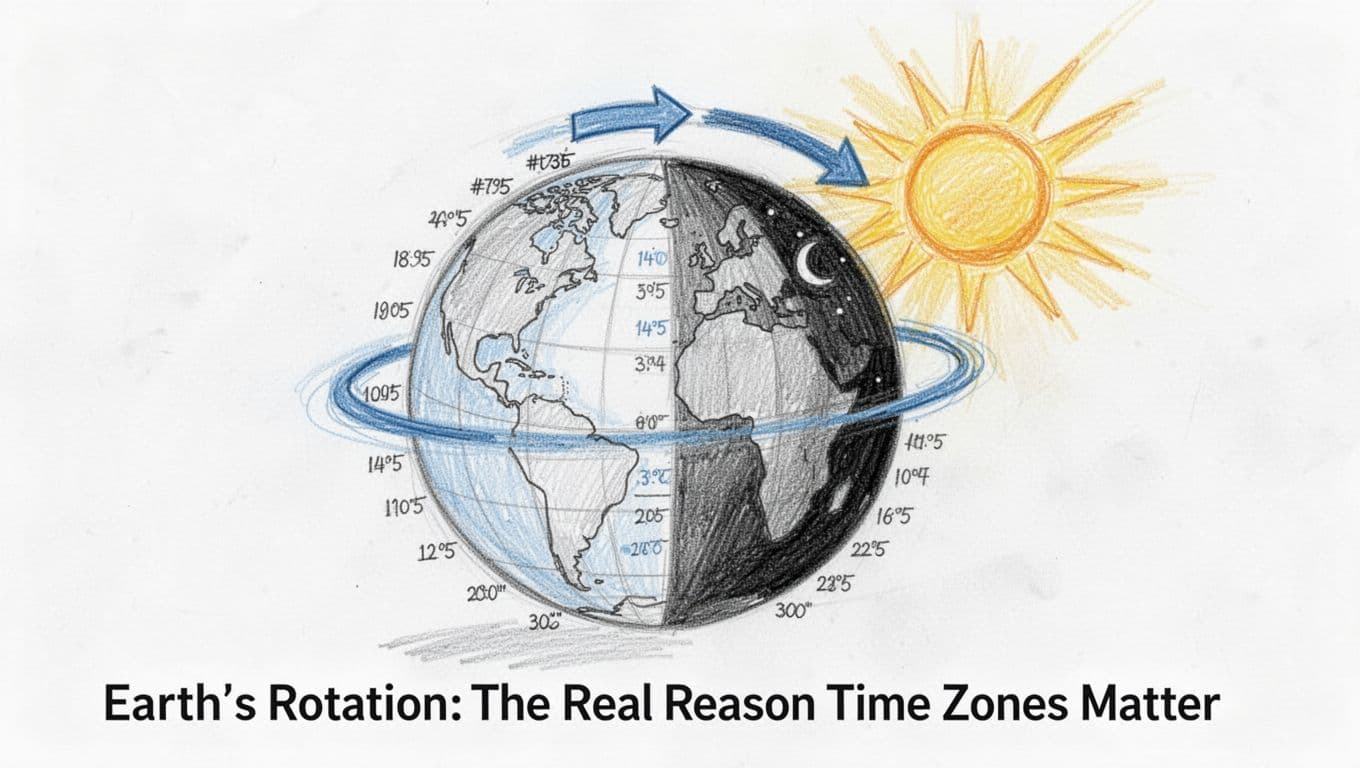
Earth spins once roughly every 24 hours. As it turns, sunlight moves across the planet. That means when it’s morning in one place, it can be evening somewhere else. If you tried to run one single clock for the whole Earth, your “morning” would fall at random times depending on where you lived.
Here’s the key idea: one full rotation is 360 degrees. Divide 360 by 24 hours, and you get 15 degrees per hour. In other words, as you move about 15 degrees of longitude, the sun shows up about one hour earlier or later.
Without time zones, sunrise could land near midnight in some far-west regions, while far-east places would see it at a normal morning hour. Work schedules, school start times, and public transport would fight the sun every day.
Time zones fix that mismatch. They let most people in a region live with daylight at sensible hours. Even if the sun still rises and sets at slightly different times inside the zone, the clock stays consistent across a big area.
A good analogy is a spinning pizza. As it rotates, one slice reaches the “heat” of daylight first. Time zones are like that shared schedule for which slice gets the heat, based on where you are.
If you want the math tied to the real offsets, this explainer on the 15-degree rule connects the geometry to what clocks actually do.
Sunrise Science in Simple Terms
Longitude lines run east and west, not north and south. So when you travel east, you usually move into a place where the sun arrives earlier.
That’s why flying east often feels like you “lose” time. You’re stepping into an earlier sunrise schedule, but your body clocks need time to catch up. Flying west often feels like “gaining” time, because the sun arrives later than it did back home.
Now think about the poles. As you get closer to the North and South Poles, the sun’s behavior gets extreme. Some times of year bring long daylight, then sudden darkness. Those patterns don’t match the clean “day-night every 24 hours” rhythm people expect near the equator. That’s one reason time zone boundaries can behave oddly in polar regions.
Still, the 15-degree-per-hour idea stays the anchor. It explains why offsets often land on whole hours, and it explains why local time shifts feel predictable when you cross major longitudes.
How the World Got Divided into 24 Time Zones
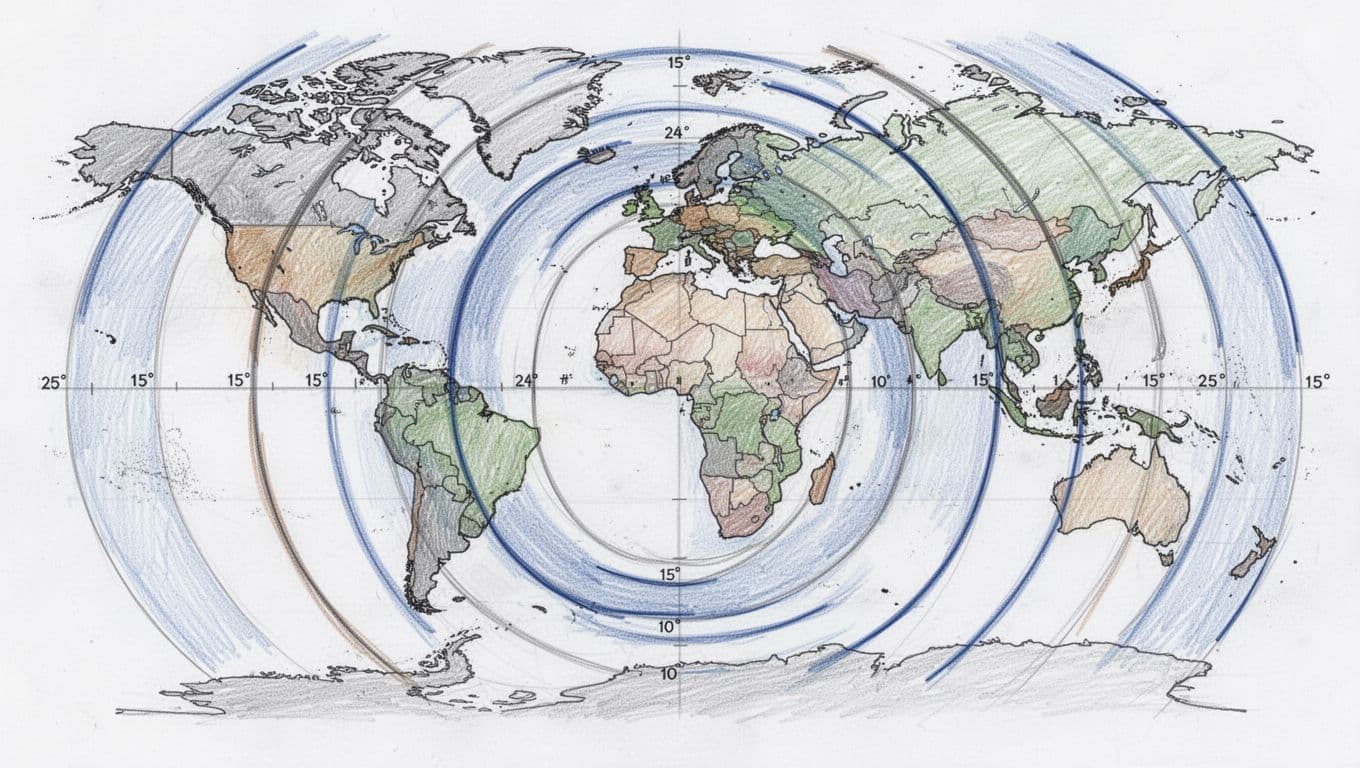
Once people agreed to standardize, the next step was simple: divide the world into broad bands. Many time zones trace back to 15-degree meridians. Each zone is defined as an offset from a reference system called UTC.
In most day-to-day life, you’ll see zones listed relative to UTC. That reference uses the prime meridian at Greenwich as the baseline. Then time zones go east with higher offsets and west with lower offsets.
In an ideal setup, there would be 24 main offsets. In practice, you’ll see more variety because borders and rules don’t follow straight lines. A time zone can also shift in unusual increments, like half-hour or quarter-hour offsets.
If you want a quick reference for what a time zone is, plus the range of offsets, Wikipedia has a clear overview of the concept and how zones work with UTC. See time zone basics.
Also, remember this: “24 time zones” doesn’t mean the planet has only 24 clock values. You’re seeing the common primary divisions. Other systems and political decisions create extra offsets.
In the US, you’ll typically hear about multiple time zones because the country spans a lot of longitudes. It’s also why your phone calendar can feel so helpful while you travel, even when your watch still hasn’t updated.
Boundaries That Don’t Always Make Sense
Time zones should, in theory, follow longitude. In real life, they follow people.
Borders matter. Countries want their internal travel, TV schedules, and business hours to match. So zones often bend to follow state lines, national borders, or regional needs. As a result, you can cross an invisible time boundary without seeing any big geographic change.
Russia is a great example. In 2026, Russia has 11 time zones. That’s partly because of geography and partly because of how regional administration works. Even when the offsets look different on a map, clocks stay consistent within each zone.
Politics also explains why you might see a time zone boundary slice through areas you think should belong together. For people in communications and logistics, that “doesn’t make sense on a map” feeling is exactly why standardization exists.
Tricky Parts Like the Date Line and Daylight Saving
Two things make time zones feel especially weird: the International Date Line and daylight saving time.
The Date Line isn’t just a line on a globe. It decides which side of the planet has which calendar day. It zigzags to avoid splitting island groups in half, because that would create constant confusion for travel and shipping.
Daylight saving time (DST) adds a second layer of mess. People change the clock to get more evening daylight in summer. That helps some routines, but it also disrupts sleep for many people.
In the US and many other places, DST rules change on specific weekends each year. Europe follows its own schedule too, which brings its own set of headaches when you coordinate across oceans.
Crossing the Date Line: Yesterday Meets Tomorrow
Cross the International Date Line, and your date can jump.
That sounds dramatic, but it’s consistent. When you move across that line, the calendar day changes so the planet keeps one coherent system for dates. NOAA explains the Date Line as a “line of demarcation” between consecutive calendar days. Learn more with What is the international date line?.
In general:
- Crossing eastbound makes the date earlier by one day.
- Crossing westbound makes the date later by one day.
In practice, the line bends so that countries and islands stay mostly intact. Wikipedia’s International Date Line page also explains the boundary concept and why it deviates around some territories.
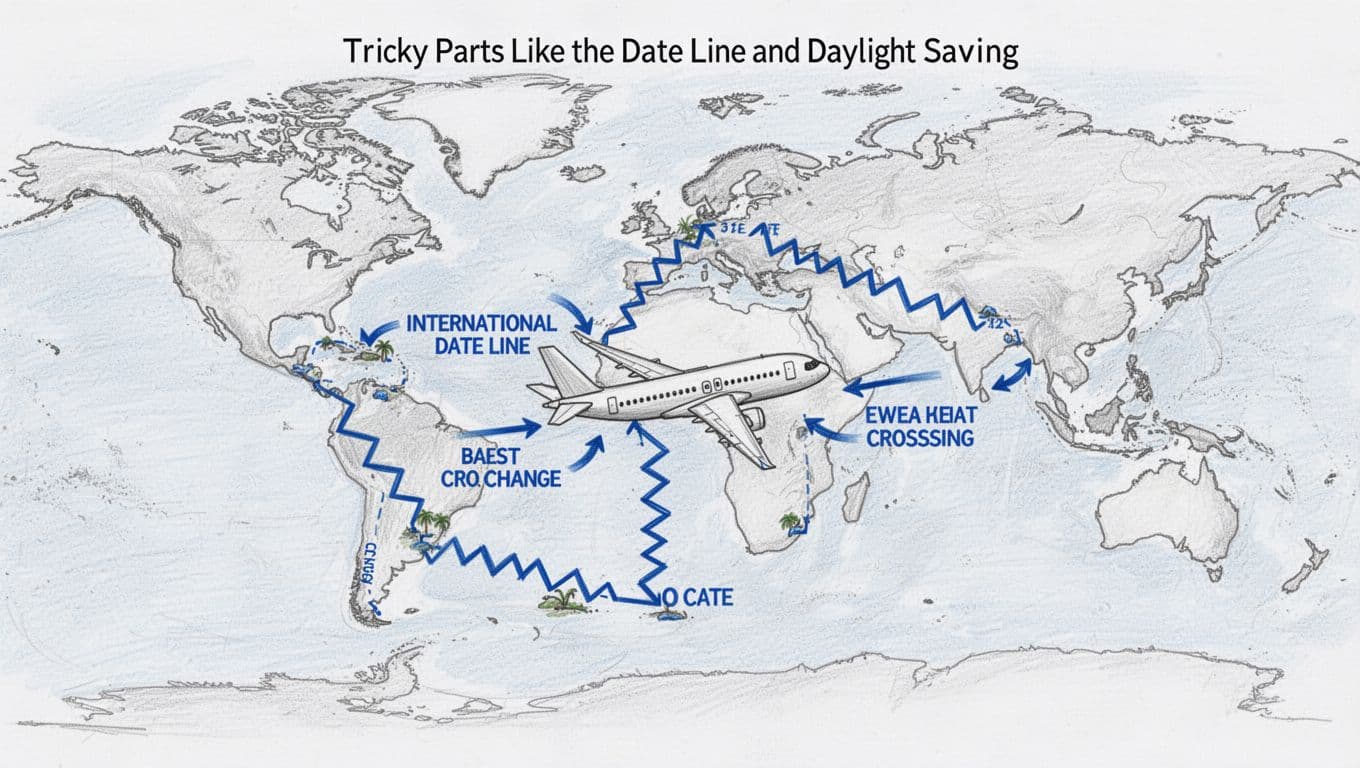
Here’s the kind of scenario that sticks in your memory. Say you fly across the Pacific from the US toward Asia. You might board on a Monday and land still feeling like it’s Monday, but your calendar could say Tuesday (or the opposite), depending on your direction and the Date Line crossing.
The point isn’t to memorize every exception. The point is to remember that the Date Line exists to keep calendars consistent.
Daylight Saving Time Pros and Cons
DST asks people to shift their clocks forward by one hour in warmer months. The goal is simple: more daylight in the evening.
But the side effects show up fast. Sleep schedules can take a hit at the start of DST. Then people feel it again when clocks move back near the fall.
If you care about what’s happening right now in 2026, Europe still uses DST. As of late March 2026, Europe switched into summer time on Sunday, March 29, 2026, with clocks moving forward by one hour. For timing details, see Europe starts DST 2026.
The debate never ends. Some people want DST kept, arguing for better evening light and energy habits. Others want it removed because it changes sleep and can affect health. For arguments on both sides, the Daylight Saving Time debate has a clean pro-and-con structure.
A quick takeaway: DST isn’t about making time zones smarter. It’s about choosing how daylight lines up with everyday routines.
Surprising Exceptions and Cool Facts About Time Zones
Not every country treats time the same way. Some keep it simple. Others spread out complexity on purpose.
That’s one reason time zones feel like a map puzzle, not a math lesson.
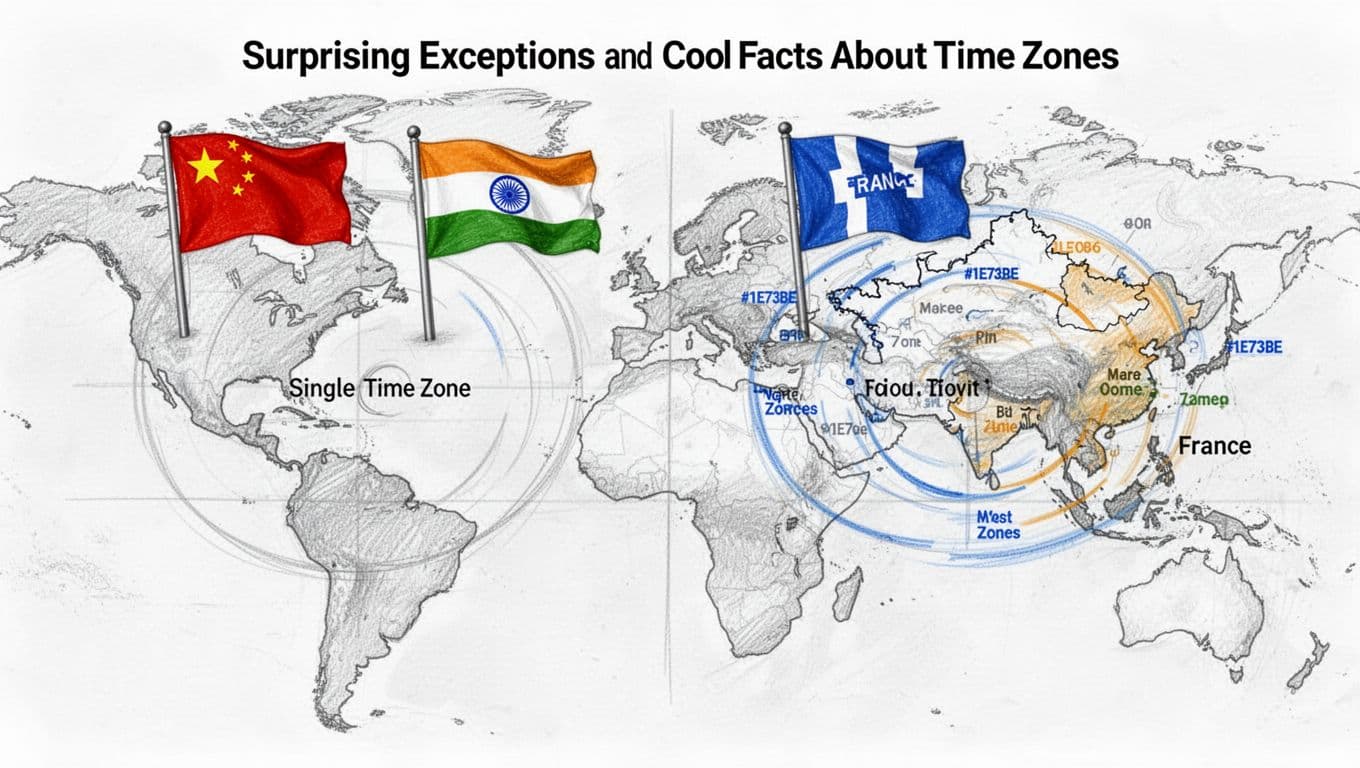
If you’ve ever heard, “China uses one time zone,” you’re already halfway to understanding the next theme. Huge countries sometimes use one standard time for the whole nation. Others split into many zones to match local daylight better.
Then there are the places with unique offsets that don’t fit neatly into a whole-hour pattern.
Countries That Ignore the Rules
China runs on a single national time zone, commonly called Beijing time. That means one clock for a vast area. As you travel across the country, the sun still rises and sets at different local moments. So daily life can feel “off” compared to what the clock suggests.
India also standardizes its time nationally, using one main offset for most of the country. That helps coordination, especially for rail and nationwide services.
France takes a different path. It has multiple time zones because of its overseas territories. So while mainland France might seem like “one zone” on first glance, French timekeeping spans a wider set when you consider the country’s global footprint.
And then there’s the 15-degree rule, which can still guide your intuition, even if politics redraws the boundaries.
Mind-Blowing Time Zone Trivia
Here’s a fun truth: some time zones aren’t “off by whole hours.” Nepal, for example, uses UTC+5:45. That 45-minute step is rare. If you want the details and history behind that offset, see UTC+05:45.
Another trivia point: time zones aren’t straight lines on the ground. They often follow where people actually live, work, and travel. So crossing into the next zone can feel like a sudden paperwork change, not a visible geographic event.
You’ll also hear that the International Space Station uses UTC. That’s sensible, because satellites and space missions don’t follow a single “local sunrise.” UTC stays consistent in a place where “time zone boundaries” have no meaning.
Finally, one last misconception worth dropping. Time zones aren’t meant to make every sunrise happen at 7:00 a.m. They’re meant to make schedules work across large regions. The sun will always be uneven. Time zones aim for practical agreement.
Time zones are a shared schedule for daylight, not a perfect match to the sun.
Conclusion
Time zones exist because Earth rotates, and the sun hits different places at different times. They also exist because humans needed one reliable way to coordinate travel, business, and calls across distance.
The story started with local clocks that worked fine for small towns. Railroads and global communication pushed the world toward standardized zones, anchored to a prime meridian. Then came the extras, like the International Date Line and daylight saving time, which keep calendars and daylight routines from falling apart.
If you remember one idea, make it this: time zones keep your day aligned with other people’s days. Before a trip or an important call, check a time zone converter and confirm the date too.
What’s the weirdest time zone mix-up you’ve ever had, the kind that still makes you laugh?