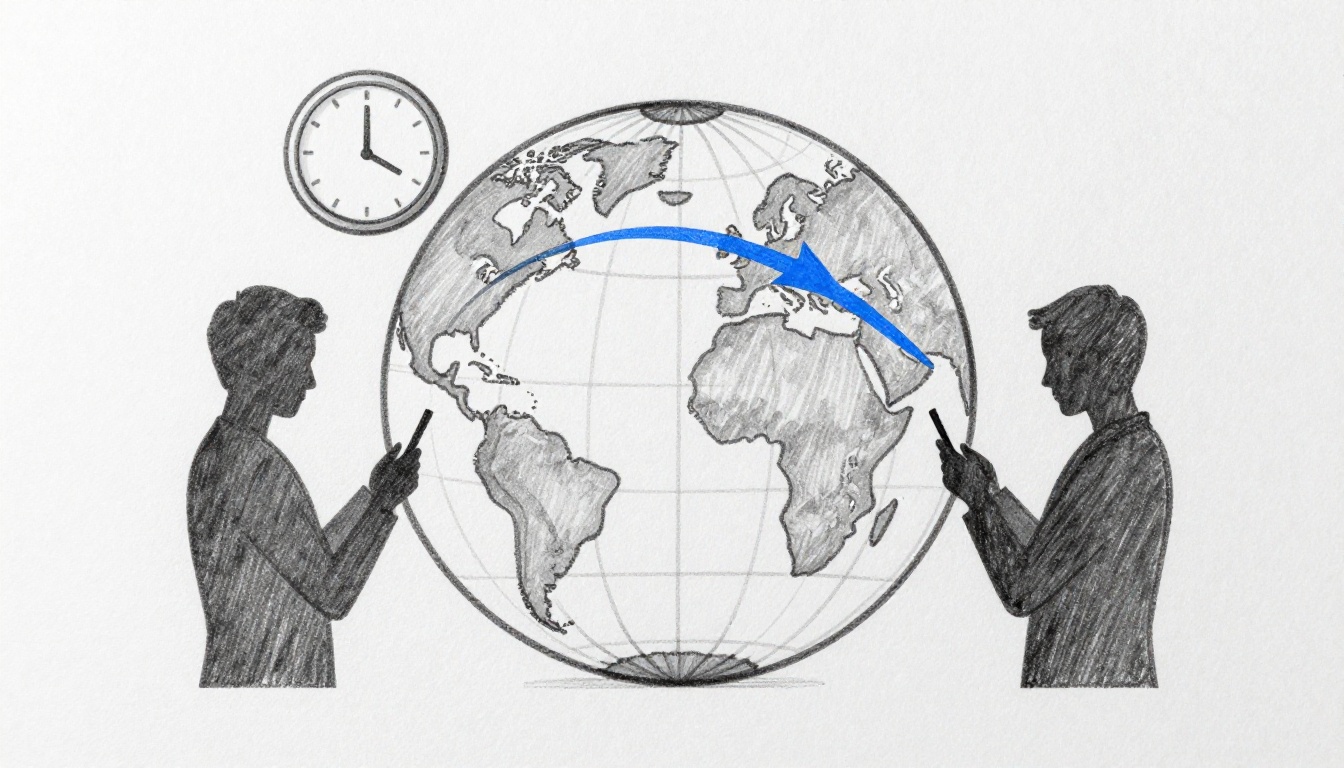
Ever planned a call with someone overseas, checked the clock, and still missed the meeting? Time differences can feel random until you know the simple rule behind them.
How are time differences calculated between countries? In most cases, you start with a shared reference time called UTC, then apply each country’s time offset. After that, you subtract (or add) the gap between their offsets.
Because time zones aren’t perfect lines and clocks sometimes change with daylight saving, there are a few surprises. Still, once you learn the method, you can figure it out fast, even for unfamiliar places.
Let’s walk through the idea step by step, with easy examples you can try right away.
Why Earth Spins Us Into 24 Time Zones
Earth spins once every 24 hours. That means the planet turns about 15 degrees of longitude per hour. So, as you move east or west, local solar time shifts.
That’s the core reason time zones exist. They split the world into chunks where clocks stay roughly in sync with the sun. Most of the time, each “zone” covers about 15 degrees of longitude, which matches the 1-hour shift.
Think of longitude like lanes on a highway. If you move one lane to the east, the sun shows up about an hour earlier. Move one lane to the west, and it arrives about an hour later. Humans like predictable schedules, so we round these shifts into time zones.
Now picture a map with evenly spaced vertical lines. The Prime Meridian (0 degrees longitude) sits at the center starting point. From there, time zones “fan out” east and west.
If you want a quick cross-check while learning, you can compare local zones to UTC using guides like Time Difference to Time Zone – UTC. It’s handy when you’re unsure which offset a place uses.
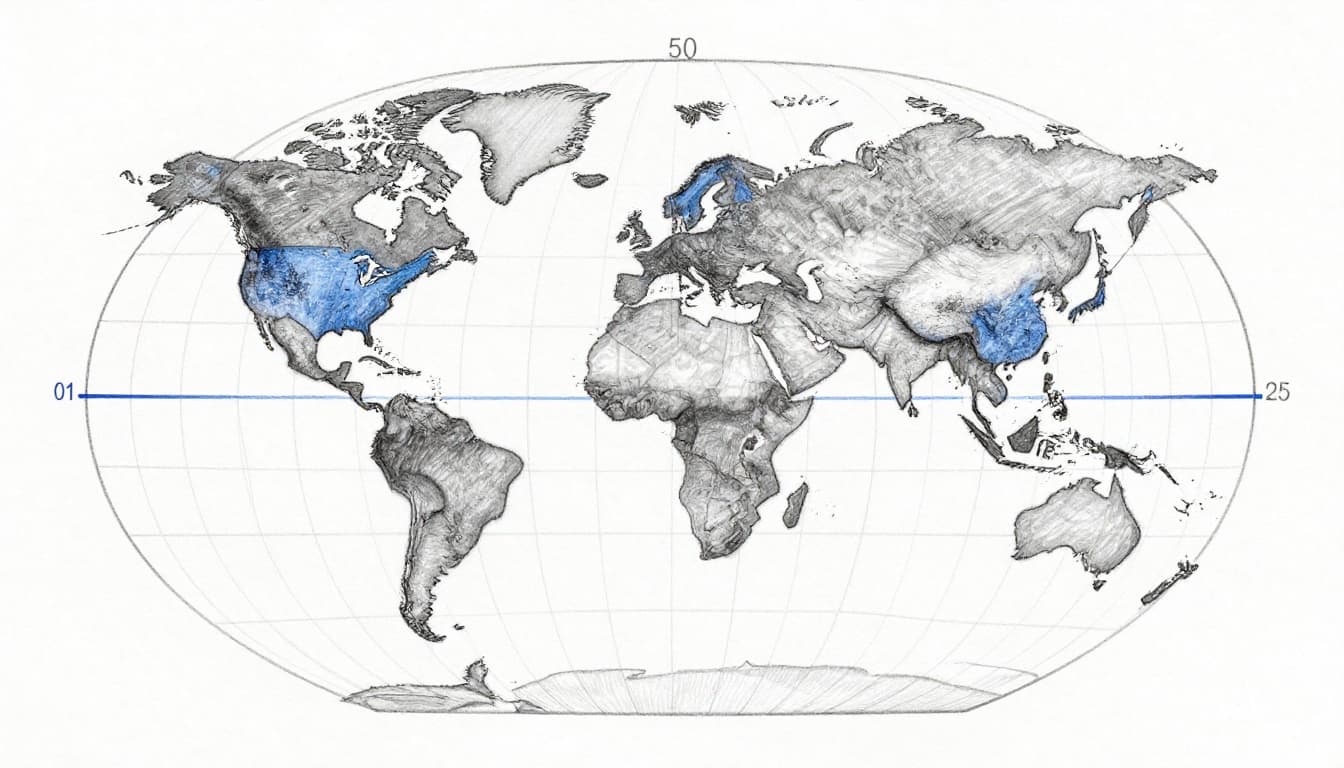
Important detail: real borders do not follow pure longitude lines. Countries adjust zones for politics, travel, and convenience. So two places near the same longitude can still show different times.
The Prime Meridian’s Role as Time Zero
The Prime Meridian runs through Greenwich, London. It’s set at 0 degrees longitude, and it gives the world its starting point for time calculations.
Because the Earth has 360 degrees in a full circle, and 24 hours in a day, the math works out like this:
- 360 degrees ÷ 24 hours = 15 degrees per hour
- So each time zone is roughly 15 degrees wide
When you see “UTC” on a clock, you can treat it like “time at the Prime Meridian.” Then other places shift forward or back from that baseline.
How Longitude Shapes Your Local Time
Longitude is the “distance east or west” from the Prime Meridian. And that distance maps to time.
Rule of thumb:
- Move 15 degrees east and the local time is about 1 hour later
- Move 15 degrees west and the local time is about 1 hour earlier
For example, suppose City A sits on UTC+0 and City B sits on UTC+1. City B is 1 hour ahead. That fits the idea that it’s farther east by about one time-zone lane.
However, borders adjust the real map. A country might stretch across several longitudes, yet still pick one offset. In other words, time zones match longitude in theory, but follow human decisions in practice.
UTC: The Steady Beat Keeping Global Time in Sync
UTC stands for Coordinated Universal Time. It acts like the world’s “steady beat.” Instead of trying to compare two countries directly, you compare each country to UTC.
Here’s why that matters: comparing “Country A to Country B” can get messy. But comparing “Country A to UTC” and “Country B to UTC” keeps things clean.
UTC offsets tell you how far ahead or behind a time zone is. For instance:
- UTC+5 means the local time is 5 hours ahead of UTC
- UTC-4 means it’s 4 hours behind UTC
You’ll see this used in flights, coding, international scheduling, and time-zone tools. Also, UTC itself doesn’t shift with daylight saving, which makes it reliable for calculations.
If you learn one concept today, make it this: use UTC offsets as your starting step, then do simple subtraction.
Decoding UTC Offsets Around the World
UTC offsets come in whole hours, but also in half hours. That’s where time difference math stops being “always the same.”
Common examples:
- UK (winter) often uses UTC+0
- US East (standard time) often uses UTC-5
- Japan uses UTC+9
- India uses UTC+5:30
For a plain-language explanation of what these offsets mean and how to read them, see How to Read UTC Offset Calculations – Meet Momentum.
One quick warning: don’t assume a country always stays on the same offset all year. Daylight saving time can move the clock by 1 hour, even though UTC does not change.
Here’s a simple comparison table for the “shape” of offsets at a glance.
| Time zone label | UTC offset | Meaning |
|---|---|---|
| UK winter | UTC+0 | Same hours as UTC |
| US Eastern (standard) | UTC-5 | 5 hours behind UTC |
| Japan | UTC+9 | 9 hours ahead of UTC |
| India | UTC+5:30 | 5.5 hours ahead of UTC |
Once you know the offsets, the next step is subtraction.
Your Simple Guide to Calculating Time Differences
Calculating time differences is mostly about direction and subtraction. But you can keep it simple by always using UTC as the middle point.
Step-by-Step Math with Real Numbers
Follow this routine when you need to convert between two countries:
- Find each place’s UTC offset for that date.
Offsets can change with daylight saving time. - Subtract the offsets.
Take the UTC offset for the origin, then compare it to the destination. - Use the sign to pick ahead or behind.
If the destination has a higher UTC offset, it’s “ahead.”
Let’s do an easy one from the outline idea.
- Spain is commonly UTC+1 (during its daylight saving period)
- China is UTC+8 (China stays on one time zone)
Difference: UTC+8 minus UTC+1 = 7 hours.
So when it’s noon in Spain, it’s 7:00 PM in China.
Now another example:
- Berlin is UTC+1
- Tokyo is UTC+9
UTC+9 minus UTC+1 = 8 hours.
Berlin noon becomes Tokyo 8:00 PM.
A practical tip: if you’re doing this for real scheduling, check the destination’s offset first. People tend to remember “what time it is there,” not “what time it is at UTC.”
To test your thinking without heavy math, you can also use a calculator like Time Difference Calculator when you’re learning.
Quick Tip: Use Apps or Maps for Offsets
You can absolutely use tools to avoid mistakes. Still, you should understand what the tool is doing.
Most phone “world clock” apps show:
- the city
- the current local time
- the UTC offset (sometimes)
If an app tells you “X hours ahead,” treat it as confirmation of your method. Then when the date changes (especially around daylight saving), you’ll know why the time shifted.
For your own mental check, ask:
- “Is the destination east or west?”
- “Did the offsets change since last week?”
That’s often enough to catch errors before you send the invite.
Sneaky Twists That Mess with Time Calculations
Time differences can break your confidence for one reason: clocks change, borders don’t match clean lines, and some regions use unusual offsets.
The biggest troublemakers are:
- daylight saving time
- half-hour and quarter-hour zones
- the International Date Line
Let’s handle each one.
Daylight Saving Time and Why It Confuses Everyone
Daylight saving time (DST) shifts the clock, usually by one hour, to make better use of daylight.
For example, the UK may be on BST (British Summer Time) in summer, which usually means the offset is UTC+1 instead of UTC+0.
The US also switches DST, but on different dates. In 2026, the US DST start and end dates are:
- Starts: March 8, 2026 (clocks spring forward at 2 a.m.)
- Ends: November 1, 2026 (clocks fall back at 2 a.m.)
Europe and the UK switch on the last Sunday of March and October. In 2026:
- Starts: March 29, 2026 (clocks spring forward)
- Ends: October 25, 2026
If you want a single place to check DST changes by country, see Daylight Saving Time Around the World 2026.
Also note: not everywhere uses DST. Japan and India do not use it, so their offsets stay steady all year. Australia has DST too, but it varies by state. Some places start in early October, while others never switch.
So if your calculation feels “off by one hour,” DST is the first suspect.
DST doesn’t change UTC. It changes local time, so your UTC offset for that date changes too.
Half-Hour Zones and the Date Line Drama
Half-hour zones happen when a country’s offset isn’t an even number of hours.
India is the famous one:
- India uses UTC+5:30
- That means it can land 30 minutes between common whole-hour zones
So if you compare India (UTC+5:30) with a place on UTC+5:00, India is 30 minutes ahead.
Now for the date line. The International Date Line sits near 180 degrees longitude. It mostly flips the calendar date when you cross it.
Here’s the key idea:
- If you travel east across the Date Line, you typically lose a day
- Travel west, you typically gain a day
Time doesn’t “teleport” across the world in one jump. Instead, the date changes because of how the calendar is assigned to longitudes.
That’s why you can land somewhere with the “same clock time” conceptually, yet still be on a different day.
Time Differences in Real Life: Country Showdowns
Let’s make it concrete. Suppose it’s noon UTC. What time is that around the world?
For a quick mental map, use this table.
| Location | Typical UTC offset | Local time when it’s noon UTC | What that feels like |
|---|---|---|---|
| London (often UTC+0 in winter) | UTC+0 | 12:00 PM | Midday |
| New York (standard) | UTC-5 | 7:00 AM | Breakfast or morning |
| New Delhi (India) | UTC+5:30 | 5:30 PM | Evening tea |
| Tokyo | UTC+9 | 9:00 PM | Dinner time |
| Sydney (varies by DST) | UTC+10 | 10:00 PM | Late night |
Notice how fast it flips. Noon in one place can be morning in another, or even late at night across the planet.
Now let’s add the real-world twist with DST timing. During parts of March, the UK and the US do not switch on the same day. As a result, the time gap can temporarily differ by an hour.
That’s why your “it’s usually 5 hours” rule can fail for a few weeks each year. The fix is simple: use the correct UTC offsets for the specific date.
When you picture it, the schedule makes sense. Noon in London might be breakfast in New York and dinner in India. It’s not random, it’s math plus clock rules.
Conclusion
So, how are time differences calculated between countries? You compare both places to UTC, then subtract the UTC offsets to find how far ahead or behind one location is.
Earth’s rotation and longitude explain the broad structure. UTC makes the actual comparison simple. And DST, half-hour offsets, and the International Date Line explain why real life sometimes feels messy.
Next time you plan an international call, try it the same way: grab the date, find each UTC offset, subtract, and double-check any DST changes. Then you’ll stop guessing, and start scheduling with confidence.
What time mix-up have you had before, and what calculation would have fixed it?