Spring can hit hard when you wake up groggy after losing an hour of sleep, even though the evenings start to feel brighter. Daylight Saving Time (DST) is the practice of moving clocks forward one hour in spring and back in fall so you can make better use of evening daylight. It doesn’t create extra sunlight, it just shifts when you experience it.
You might also wonder why your state does it while another nearby place doesn’t, because DST isn’t universal. It’s currently observed in about 40% of countries worldwide, with about 70 to 80 having used it at some point, so you’ll see plenty of exceptions.
In the next sections, you’ll get the history behind DST, why countries use it, the upsides and downsides, and how 2026 U.S. dates work, plus what people argue about today.
How the Clock Switch Affects Your Daily Routine
Daylight Saving Time does not change how much sunlight the sun gives you. Instead, it changes what the clock says when you start your day and when you wrap up. In spring, the shift feels like a missing page in your schedule, because your morning arrives one hour “earlier” than your body expects.
That matters because daily routines run on habits. You wake up at a certain time, leave for work or school at another, and plan errands around daylight. When DST flips the clock, the whole day moves underneath you. Suddenly, your phone screen says it’s time to go, but the sky still looks half-asleep.

How the Clock Switch Affects Your Daily Routine
Sleep usually takes the first hit. On the spring “forward” night, I’ve seen it happen to everyone in my house. The alarm goes off, and I feel like it came too soon, even though it’s doing exactly what it always does. The next morning can feel foggy, and that can make everything else feel harder to start.
Then come the domino effects for the rest of the day:
- School mornings get darker. In many places, kids wait for buses in dim light. Even if the bus time stays the same, the world looks less bright because the clock changed.
- Commutes can feel off. When you leave an hour “earlier” by the clock, you meet different traffic patterns and fewer daylight breaks. Drivers can also be more cautious when roads look darker at pickup times.
- Household schedules shift. Breakfast, getting dressed, and packing lunches can start to feel like an extra chore. You may even notice how kids resist when morning routines feel rushed.
Now, the flip side arrives later. By the afternoon and evening, it often feels like someone turned the lights up outdoors. For me, that shift brings small wins: longer playtime outside, easier errands, and more time for casual plans. After work, I’m more likely to catch a backyard barbecue, squeeze in a round of golf, or just take a walk without rushing the sunset.
In other words, DST turns your day into a trade: darker mornings in exchange for brighter evenings. Next time the clocks change, watch for how that trade shows up in your own routine.
From World Wars to Energy Crises: Key Milestones
Daylight Saving Time did not appear because one person flipped a switch and everyone agreed. It grew out of practical needs, tight wartime budgets, and repeated energy worries. In other words, DST has a history that looks less like a neat invention and more like a chain of “we need this now” decisions.
To see how that happened, picture time like a budget. When fuel, power, or lighting costs rise, governments look for ways to get more out of the daylight they already have.
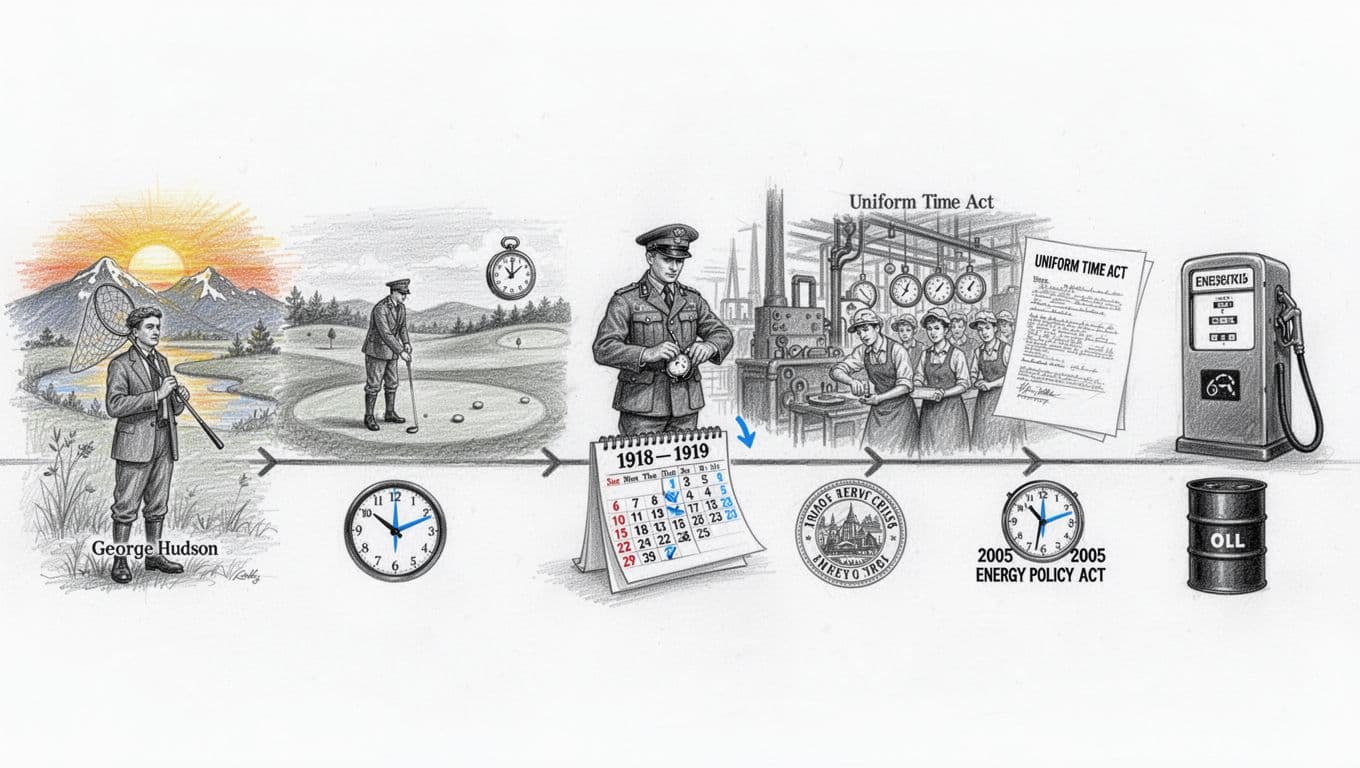
George Hudson (1895): Evening Time for Bug Collecting
The story often starts far from Washington, D.C. In 1895, George Hudson, a New Zealand naturalist and bug expert, proposed shifting time so people would have more daylight after work. He wanted more workable hours for evening collecting, not fewer.
Hudson’s idea was simple. If the sun stays the same, why not move your clock to match your day? For him, the payoff meant more time outdoors, less wasted evening darkness, and a better chance to spot insects when they were most active.
This matters because it shows the core logic behind DST. It isn’t about creating sunlight. Instead, it’s about timing daily life so people use the light they already get.
Also, Hudson’s proposal reminds you that DST was never just a policy debate. It started as a real-world need, the kind that affects hobbies, work, and routines.
William Willett (1907): Golfers, Clocks, and Extra Evening Light
Next comes William Willett in England. In 1907, a golfer, he pushed an idea that sounded almost playful: adjust clocks so people could enjoy more evening daylight.
Willett campaigned so people would move clocks forward in spring and back in autumn. His effort drew attention, but it still took time for governments to act.
During this era, countries didn’t all share the same timekeeping habits. Many places managed time locally, so a “national” DST plan could feel messy. That’s part of why the idea lingered while other priorities took over.
Yet Willett’s role is important because he helped turn a personal concept into a public one. In later decades, governments would echo the same promise: if you shift the clock, you can shift when the day feels bright.
Germany in 1916 (April 30): WWI Fuel Savings
The first widely recognized DST adoption tied directly to war needs. Germany began DST on April 30, 1916, during World War I. The goal focused on reducing fuel use for lighting and other energy needs.
Think about it this way. Wartime economies faced tight supplies, so governments counted costs carefully. If people can do more in daylight, they burn less fuel in the evening. That simple math makes DST a tool, not a lifestyle choice.
Germany’s timing also shows how wartime pressure can speed up adoption. When the lights in homes and workplaces matter to total energy use, aligning work with daylight becomes a quick win.
In other words, DST moved from “better evenings” to practical energy savings.
The United States (1918 and 1942): Post-WWI and WWII Returns
In the United States, DST came next, also tied to war. The U.S. began DST on March 31, 1918, under the Standard Time Act, again aimed at WWI fuel savings. After the war ended, DST faded out.
Then came World War II, and the need returned. The U.S. brought DST back from February 9, 1942 to September 30, 1945, under wartime rules focused on energy use.
Here’s the pattern you start to see. DST appears when governments worry about power and fuel. It disappears when the pressure eases.
It also explains why, before the mid-1900s, you could see state-by-state variation in the U.S. Many states had their own rules, and businesses in neighboring areas often faced confusing clock differences.
For everyday people, that meant more than one “clock reality.” For cities and farms at the edge of a boundary, the day could feel out of sync.
1966 Uniform Time Act: A Nationwide Rule
By the 1960s, inconsistent rules created headaches. The Uniform Time Act of 1966 helped standardize DST across the country.
Under this law, DST generally starts in spring and ends in fall on set dates. States still get options, though, and that’s where you see famous exceptions like Arizona and Hawaii (which do not follow the same DST switch pattern).
This was a big shift. Instead of scattered local experiments, the U.S. moved toward a single framework. As a result, rail schedules, TV schedules, and cross-state commuting work smoother.
If wartime policies made DST temporary, the 1966 Act made it predictable.
The 1970s Oil Push and State Variations Before 1966
After standardized rules arrived, the energy story did not stop. The 1970s oil crisis brought renewed attention to energy use, and DST again became part of the conversation.
The logic stayed consistent: if you shift the clock, you shift the hours when people rely on artificial lighting. In a period when gasoline and electricity costs felt personal, that promise carried real weight.
Also, the U.S. had already lived through the confusion of state-level differences before 1966. Farmers, factory towns, and growing suburbs all felt the effects when neighboring areas picked different rules.
Those variations helped set the stage for uniformity. People wanted fewer surprises, especially when life already ran on schedules like school, shifts, and commuting.
In short, DST kept returning because energy worries kept returning.
2005 Energy Policy Act: March to November
The most recent major overhaul came with the Energy Policy Act of 2005. This law changed DST dates so it runs longer each year, starting later in spring and ending earlier in fall.
Now DST begins the second Sunday in March and ends the first Sunday in November. The policy goal tied back to energy use and making better use of daylight during months when people use power after work.
One way to picture the change is like extending a brighter “after-hours” window. Schools, families, and retail schedules all feel that shift. As a result, DST doesn’t just affect clocks, it affects consumer timing, outdoor activity, and how communities plan their evenings.
And yes, lobbying played a role in shaping the conversation around extended daylight. Candy makers pushed for more time in the after-school window, since longer daylight can mean more kids out and about.
That’s how DST history ends up looking. It mixes energy policy with everyday incentives, all tied to one stubborn fact: the sun rises and sets on its own schedule. Governments just try to meet it halfway.
Why Do We Use Daylight Saving Time Today?
People don’t use Daylight Saving Time (DST) just because it sounds nice. Most of the time, the pitch comes down to a simple tradeoff: brighter evenings in exchange for the morning clock jump. That shift can change how long families stay out, where they spend money, and what kinds of plans feel realistic after work.
In the U.S., this matters because daily life runs on schedules. Schools start at fixed times, many offices end in the late afternoon, and errands often happen right after work. When the sun sets later, it feels like the day gained an extra hour for outside life, even though the sun didn’t “create” any more light.
At the same time, DST is still debated, and the evidence can be messy. Some benefits show up in older research, while newer studies question whether the downsides, like sleep disruption and safety risks, outweigh the gains. So, what benefits do people point to most often? Let’s start with the ones you can feel on an ordinary week.
Proven Benefits for Evening Hours and Businesses
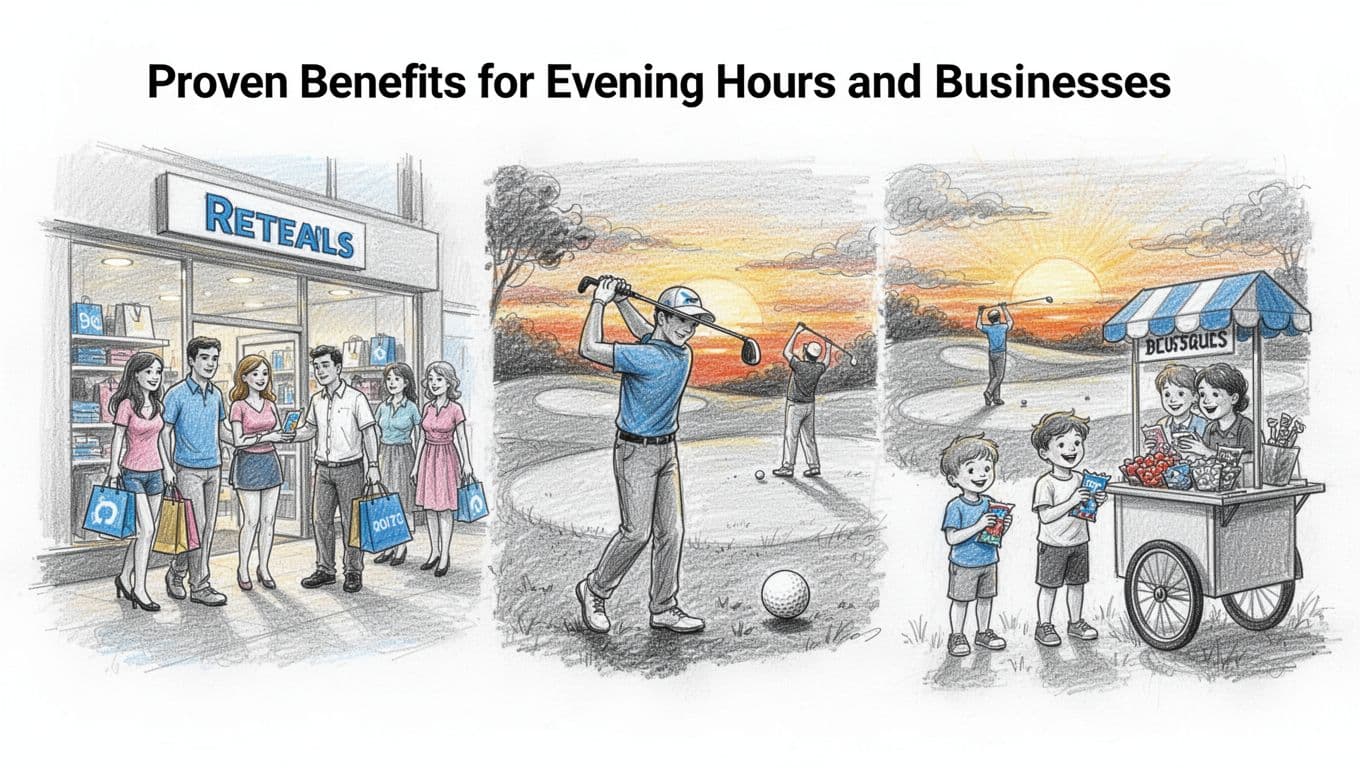
DST supporters argue that evening daylight changes behavior. When stores look busy and parks feel safer to use, spending and recreation tend to rise. Think of it like stretching a familiar weekend routine into more weekdays. You don’t just do more, you do it after work.
Here are the main ways DST can help evening activity and business, based on research discussed in public analysis and reporting:
- Retail shopping gets a boost after work. One often-cited pattern is that spending shifts toward the period with more evening light. For example, Scioto Analysis points to a finding where retail spending in Los Angeles fell after DST ended, implying the opposite pattern in the spring and summer months (even though the best numbers vary by study). See what daylight saving does to the economy.
- Outdoor recreation and sports get more time. In broad terms, DST gives people more daylight overlap with school, work, and typical after-dinner routines. That can mean more walking, kids playing outside, and more people choosing sports over screens.
- Local “after-hours” businesses may gain revenue. BBQ spots, casual dining, and other evening-focused businesses can benefit when more people are out later. NPR has also discussed how DST changes timing for retailers, though it notes the policy debate around whether this is a substitute for real energy policy. Read the reasoning behind daylight-saving time changes.
Golf and candy often come up in popular discussions because they match the “stay out longer” story. Still, as of the latest public summaries, there aren’t many widely accepted, recent U.S. statistics that tie DST directly to golf sales or candy sales in a way that’s clean and consistent. Quartz has covered the business angle of DST, including golf and other everyday purchases, but it also shows how claims can be easier to make than to prove with tight, modern data. See DST’s business story.
So what’s the bottom line for businesses? DST can shift foot traffic and purchases toward the evening window. For sports and recreation, it can make outdoor plans feel doable. Yet the “proof” depends on the specific study, the city, and the year, which is why the debate keeps coming back.
DST is often sold as an evening-hours policy, not an energy miracle. Even so, those extra hours can matter for retail traffic and outdoor activity.
If you’re wondering why farmers rarely get the credit they’re promised in talk shows, that’s next. Many people claim DST helps farmers because it “matches the sun,” but the real picture is more complicated, especially for modern farm schedules and equipment. I will generate one relevant image using the specified style.{“prompt”:”A hand-drawn sketch style calendar page with highlighted dates for daylight saving time changes, showing a spring forward and fall back theme, clean white paper background, graphite linework, light shading, cohesive monochrome look with subtle blue accent, no readable text”,”sectionTitle”:”US Start and End Dates You Need to Know”,”imageIntent”:”Help readers visualize the spring forward and fall back dates for 2026″}## How Daylight Saving Time Works in 2026
Daylight Saving Time (DST) is basically a clock edit. In 2026, the change happens on set Sundays, so you can plan ahead instead of guessing.
When DST starts, most places move clocks forward one hour (a short “loss” of sleep). When DST ends, they move clocks back one hour (an “extra” hour in the morning). Think of it like changing the cover page of your schedule, while the real day from the sun stays the same.
US Start and End Dates You Need to Know
In the U.S., DST follows one national rule for most states. For 2026, that means the familiar “second Sunday in March” and “first Sunday in November” pattern.
Here are the key dates most people use to set reminders and update devices:
| Event | 2026 Date | What you do with your clock |
|---|---|---|
| DST starts | Sunday, March 8, 2026 | Clocks jump forward at 2:00 a.m. to 3:00 a.m. |
| DST ends | Sunday, November 1, 2026 | Clocks fall back at 2:00 a.m. to 1:00 a.m. |
If you want an extra check before those weekends, see DST dates for 2026 for a quick, reliable reference.
Now, the exceptions matter, because DST is not truly “everywhere in the U.S.” Two big states skip DST in 2026:
- Arizona (mostly) stays on standard time all year.
- Hawaii also skips DST.
One more wrinkle helps you avoid surprises if you travel or schedule meetings across borders. The Navajo Nation in northeastern Arizona does observe DST, so parts of Arizona follow the change while the rest does not. That can create a one-hour gap even within the same state.
What the clock change feels like (step by step)
On the spring “forward” night (March 8), the local clock skips ahead from 2:00 a.m. to 3:00 a.m. You do not “lose” time from the sun, but you do lose one hour from your sleep window.
On the fall “back” night (November 1), the clock repeats the hour from 1:00 a.m. back to the same point. In plain terms, you get one extra hour in the morning.
Global Variations and Who Skips It
DST does not work like a universal switch. Many countries skip it, and many that do follow DST still use their own start and end dates. So if you live near a border, or you travel for work, you need more than “spring forward, fall back” in your head.
Europe’s common 2026 pattern
Most of Europe changes clocks on the last Sundays in spring and fall. In 2026, the schedule typically runs from Sunday, March 29 to Sunday, October 25 (with clocks adjusted by one hour).
To keep it simple, treat Europe like this: evenings get longer after spring, then the “extra” hour returns in autumn. If you’re planning flights, TV schedules, or cross-country calls, this shared pattern helps, but always verify the exact zone you care about.
Who skips DST (and why it surprises people)
A lot of places near the equator skip DST because daylight hours stay fairly steady through the year. When sunrise and sunset do not swing much, moving clocks adds confusion without much payoff.
Across the world, DST is far more common in places like parts of Europe and some North America regions, while many countries in Africa, Asia, and much of South America do not use it at all. For example:
- Most of Africa does not observe DST. (Egypt is the main exception often cited.)
- Many Asian countries do not use DST, including places like Japan, China, India, and Russia.
- Parts of South America skip it, including countries like Brazil and Argentina (they stay on their own standard-time rhythm).
- In North America, the “skip” list still shows up in Hawaii and most of Arizona (with the Navajo Nation exception).
If you deal with international calls, calendars can become a mess when one side changes and the other doesn’t. Here’s a practical way to stay calm: double-check your calendar event time in the time zone, not just your local time.
Gotcha: DST can shift the time difference between two places even when both cities use “the same” time format. The clocks change, so the gap changes too.
Finally, remember this rule of thumb for 2026: DST is predictable inside a country that follows one schedule, but unpredictable across borders. When in doubt, verify the time zone conversion right before the weekend of the switch.
Drawbacks Controversies and the Push to End It
People do not argue about Daylight Saving Time because they like chaos. They argue because the clock switch touches real life, from sleep to school mornings. It also bumps into politics, with different states pulling in different directions.
The push to end it sounds simple at first: pick a schedule and stop changing it. However, once you dig in, you quickly see why the debate keeps coming back every year.
Health and Safety Risks from Clock Shifts
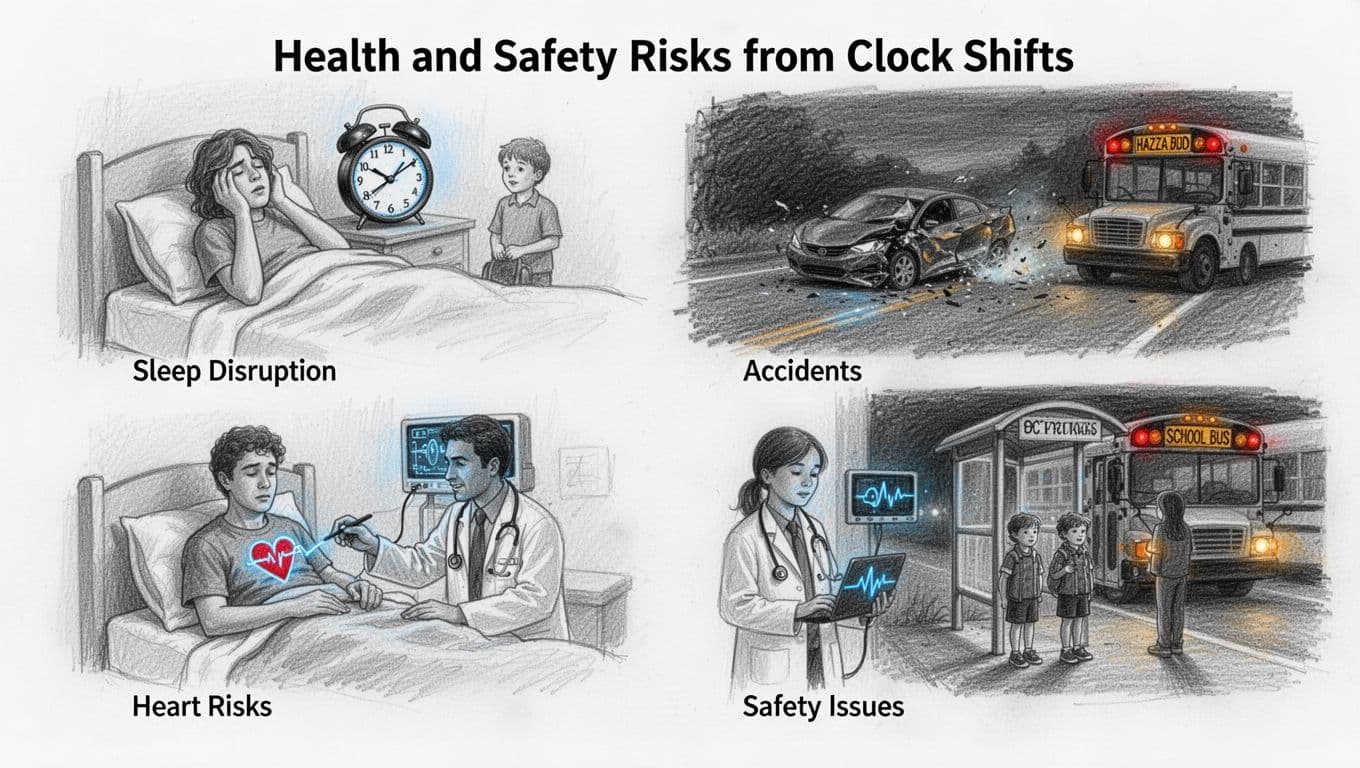
The biggest concern is sleep. When the clock jumps forward in spring, many people lose about an hour of sleep in one night. After that, their body clocks need time to catch up, and that can spill into the next days and weeks.
Health experts also point to longer-term effects for people who are more sensitive to schedule changes. Research discussed in reporting has linked DST transitions with increases in heart attacks, strokes, and motor vehicle crashes, especially right after the switch. If you want a plain-language summary of the risk conversation, see DST harms health and safety.
Here is what that looks like in everyday terms.
- Sleep disruption and mood changes: You feel it as grogginess, irritability, and worse focus. Even if you do not realize it at first, your brain still runs on a sleep schedule.
- Heart and stress strain: For some people, the shift can stress the body’s timing systems. That matters because heart risk often connects with changes in sleep and daily rhythm.
- Higher crash risk during dark mornings: When mornings feel darker, visibility drops and drivers may be more cautious. The result can be more dangerous driving conditions during peak commute moments.
- Safety issues for kids: School bus stops shift in relation to sunrise. Kids waiting in dim predawn light can raise concerns about safety, especially in neighborhoods with limited lighting.
Also, it helps to think of DST like a delayed train schedule. The sun still rises on its own timetable. Your body just has to follow the tracks the clock sets, and that can create friction.
Recent Bills and Public Opinion in 2026
Now let’s talk about the real reason DST is not “just ended” yet: lawmakers cannot agree on what to lock in. The most famous proposal is the Sunshine Protection Act, which aims to make DST permanent nationwide. Despite public attention, it has stayed stuck, with versions failing to clear the U.S. House.
Recent coverage also notes that the bill remains stalled even as supporters keep pushing and states keep lobbying. For a snapshot of the current status, see Sunshine Protection Act status update. Other reporting connects the ongoing debate to how hard it is to change a long-standing federal rule, even when public frustrations are high. See why clock changes keep going.
Meanwhile, governors and state lawmakers keep trying to move the needle locally. Colorado’s Governor Jared Polis has backed permanent DST and continues to support state-level action if the federal path stays blocked. In addition, many states introduce bills that fall into two camps:
- Permanent DST supporters: They want more evening light year-round.
- Permanent standard time supporters: They want steadier mornings and fewer clock flips.
Public opinion also shows the tension. Available polling summaries over time often find many people dislike changing clocks, but opinions split on whether they prefer permanent DST or permanent standard time. Some reporting in early 2026 frames it as “most people hate the switch,” yet Congress cannot settle on the best fixed option.
So the controversy is not only about health and safety. It also comes down to what people value most: evening daylight, morning darkness, and how much disruption feels worth it.
If Congress keeps stalling, the most likely future is more state-by-state noise, not a nationwide change. That leaves a simple question for anyone planning their year around the clock: when do the risks and public pressure finally outweigh the politics?
Conclusion
Daylight Saving Time shifts when you experience daylight, not how much sunlight exists. It began as a practical fix for energy and wartime needs, then stuck because many people like the trade: brighter evenings and longer after work hours, paired with darker mornings and the stress of changing clocks.
In the U.S., you can plan the change with confidence for 2026, DST runs from Sunday, March 8, 2026 to Sunday, November 1, 2026. Even so, the debate stays loud. Supporters keep pushing to end the clock switch, but federal action has stalled, so you still get the yearly routine (and the schedule headaches that come with it).
If you want a calmer switch this year, update your devices early, protect sleep on the first week, and keep travel plans tied to your time zone, not just your local clock. Then, share your own experience in the comments, do you prefer permanent DST (more light in the evening) or permanent standard time (steadier mornings)?
For more practical help, sign up for the newsletter (time and sleep tips) and check the related guide on managing clock changes without losing a week. What will you do differently the next time the clocks change?