
Have you ever tried to sync a call across time zones and thought, “Why can’t clocks just agree”? Flights, meetings, and even server logs depend on a shared system of standard time. The trick is that countries do not all copy the same clock. Instead, they follow a common reference point and then apply local rules.
Earth turns, and it never spins in the exact same way twice. Still, most of the world can coordinate because we use UTC (Coordinated Universal Time) as the baseline.
This post explains how the mess got fixed. You’ll see why railroads pushed the first standard time zones, how UTC became the global anchor, and how rules like leap seconds and daylight saving time fit into the plan. Along the way, you’ll also learn why agreement matters for travel, business, and daily life.
The Messy Days Before Standard Time Zones
Before standard time, every town kept its own “correct” time. Many places used noon when the sun hit its highest point. That sounds simple, but it breaks down fast when you travel.
Now imagine traveling by train in the 1800s. You’d cross miles of countryside, yet the clock in one station could be “off” from the next. Different cities could run on slightly different schedules, even if everyone claimed they were right.
Railroad timetables suffered first. A train might leave “at 3:00” by one town’s clock, then arrive closer to 3:20 by another town’s clock. To passengers, it looked like the rail service was unreliable. Behind the scenes, it was coordination failure.
This problem showed up across regions, too. As more businesses and governments planned deliveries, payments, and public events, local time became a headache.
For a vivid look at how timekeeping moved toward coordination, see the Smithsonian’s history of how time zones were built for real life, not just theory: Time Zones from the National Museum of American History.
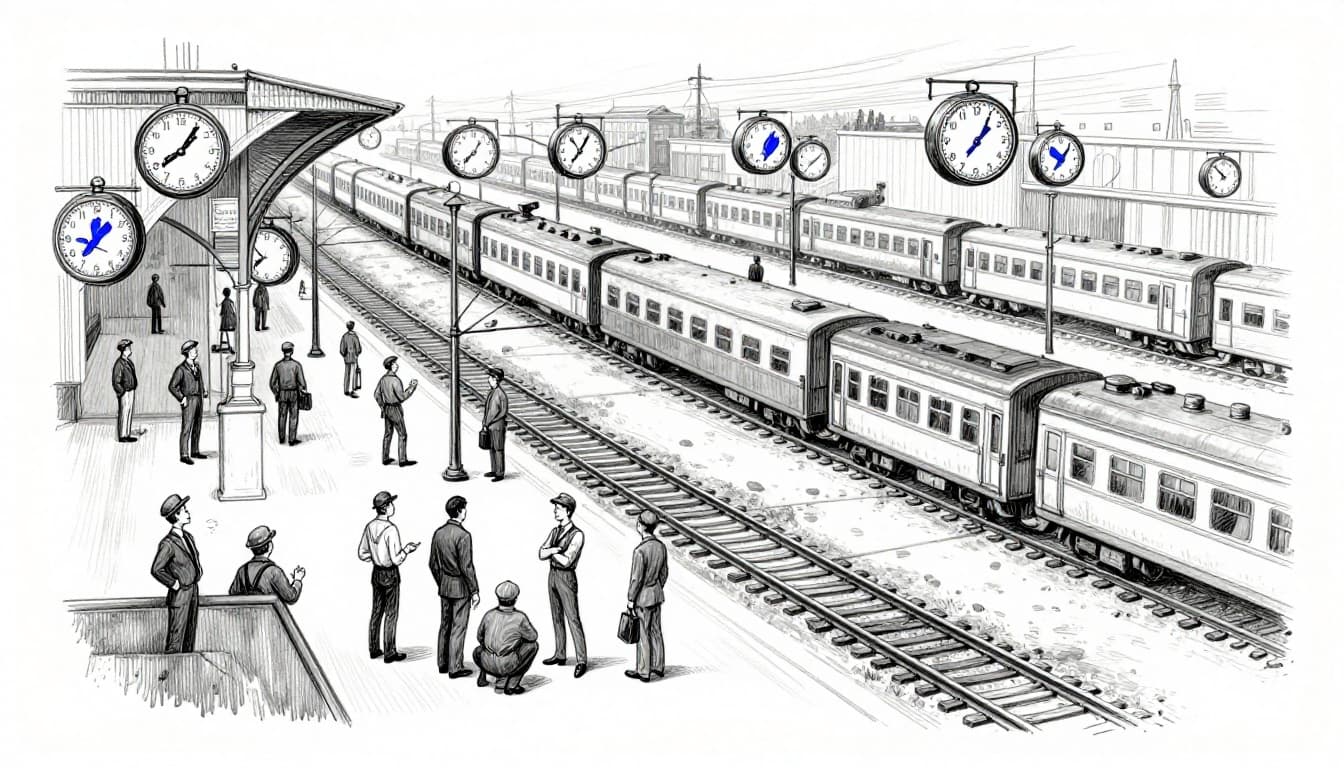
To make schedules work, countries and companies needed fewer “versions” of time. That’s where time zones came in. They turned timekeeping into a map you could actually use.
At first, the push came from industry. Railroads had deadlines, and they could not wait for every town to agree. Once companies standardized schedules, governments followed. That shift is a big reason why modern standard time feels so orderly today.
Railroads: The Real Heroes of Time Standardization
Railroads forced a hard question: how do you run a timetable across many local times?
The answer was to cut the problem into big chunks. Instead of using the sun in each town, railroads used shared clock rules across a wider area. That reduced the number of mismatches you could run into during a trip.
The scale was bigger than most people expect. In North America, the early era included many local variations, especially as lines expanded and different operators set their own practices. Even if two nearby towns used “almost the same time,” “almost” still breaks a schedule.

Rail work also spread ideas fast. Once one railway used a zone rule that aligned with neighboring lines, other companies copied it. Soon, “official time” became a practical tool for moving people and goods.
In many places, the first time zones were named after regions, not laws. You might hear Eastern time or Central time, for example. Those names made it easier for travelers to plan. Over time, governments turned those practices into official policy.
So yes, the humble train station helped shape global time. It did not do it with fancy theory. It did it because trains needed clocks that matched at speed.
Sandford Fleming’s World-Changing Idea
Railroads showed what could work. But one person helped turn scattered practices into a clearer plan.
Sandford Fleming, a Canadian engineer, pushed a global approach. His big idea was simple: divide Earth into zones based on longitude. Instead of hundreds of local times, there would be a smaller number of shared ones.
Fleming also supported a 24-hour system. That mattered because it made time more consistent across borders. It also helped planners avoid confusion during long-distance travel.
His proposal centered on using Greenwich as a reference point. Then each time zone would shift by a steady step. In modern terms, that step is about one hour per 15 degrees of longitude.
You can read more about why his thinking mattered and how it spread through the rail world in this piece from Canadian Geographic: How Sandford Fleming changed the way the world experiences time.
Here’s the key point. Countries did not have to agree on every detail of “local time.” They mostly needed an agreed method to translate clocks around the world.
That set the stage for the next leap: a single worldwide reference that everyone trusts.
UTC: How International Teams Keep the World on the Same Tick
If time zones are the “local dress code,” UTC is the standard sizing chart.
Coordinated Universal Time, or UTC, is the baseline used worldwide. It lets people in different countries compare moments without arguing about how each local clock behaves.
UTC also helps with modern technology. Networks need one shared rhythm. Aviation and finance need consistent timestamps. Even social media scheduling depends on time rules that computers can follow.
UTC exists because atomic clocks are so stable. They keep time better than Earth’s rotation alone. For practical purposes, atomic clocks set the rate. Then UTC makes small adjustments when needed to stay aligned with Earth.
If you want a readable overview of what UTC is and where it comes from, start with BIPM’s official material: Coordinated Universal Time (UTC) at BIPM.
Still, UTC is not just one clock. It’s a system built from many clocks around the world.
Think of it like an orchestra. Each musician might tune slightly differently at first. But the conductor uses a shared reference so the whole group stays in sync.
UTC plays that role for the planet. Meanwhile, local time zones tell your clock how to display UTC in your area.
Meet the Guardians: BIPM, IERS, and ITU
Several groups work together to keep UTC trusted.
- BIPM (Bureau International des Poids et Mesures): BIPM coordinates the international time scale and works with measured data from many atomic clocks. In short, it helps produce and publish the UTC time scale.
- IERS (International Earth Rotation and Reference Systems Service): Earth’s rotation is not perfectly steady. IERS watches those variations and informs the leap second process when Earth drifts enough to need an adjustment.
- ITU (International Telecommunication Union): ITU supports time scale dissemination and helps with international communications that depend on UTC.
If you want a clear, plain overview of UTC and its role in global timekeeping, ITU has a helpful summary: Coordinated Universal Time: An overview.
Now, how do time zones fit into this?
Time zones are usually expressed as an offset from UTC. For example, Eastern Standard Time is commonly listed as UTC-5. That offset acts like a translation rule. Your local clock shows “UTC plus or minus this many hours.”
So when people “agree on standard time,” they’re doing two things:
- Using UTC as the universal reference.
- Following a local offset and local rules for daylight saving.
Next, let’s look at why those local rules can differ.
Mapping Time Zones: Offsets, Borders, and Country Choices
Time zones are not just lines drawn by longitude. They also reflect politics, commerce, and history.
On paper, each zone lines up with a slice of Earth. Roughly, 15 degrees of longitude equals about one hour. But in real life, borders do not follow neat geometry.
Countries and sometimes states or provinces pick offsets that make daily life easier. That can mean aligning with neighbors for trade. It can also mean keeping a region on the same schedule as the capital.
This is one reason time zones can look “uneven” on maps. The goal is not perfect math. The goal is workable coordination.
In the United States, the U.S. Department of Transportation oversees time zone rules. It also explains how daylight saving observance works at the state level: Uniform Time from the U.S. Department of Transportation.
Here’s a simplified example of common U.S. standard time offsets from UTC:
| Region (Standard Time) | Typical UTC Offset |
|---|---|
| Eastern | UTC-5 |
| Central | UTC-6 |
| Mountain | UTC-7 |
| Pacific | UTC-8 |
Takeaway: the “agreement” is strong at the reference level, meaning UTC. The local details adjust to fit real human systems.
So if you see an odd time zone border, don’t assume it’s a mistake. It usually reflects trade routes, population centers, or past decisions that stuck.
Leap Seconds: The Tricky Fix for Earth’s Wobbly Spin
Atomic clocks tick at a steady pace. Earth’s rotation does not.
As a result, there can come a time when UTC needs a small correction. That correction can be a leap second. It keeps UTC close to solar time, so noon stays near the sun’s highest point.
Leap seconds are rare. Since 1972, only a limited number have been added. Also, the world often goes years without any change.
How does the process work?
IERS monitors Earth’s rotation and watches for drift. When drift reaches a threshold, it recommends whether UTC needs a leap second. Then BIPM and ITU handle verification and announcement steps so systems worldwide can prepare.
IERS explains its leap second role in this document: The Role of the IERS in the Leap Second.

As of March 2026, no leap second adjustment is scheduled for July 1, 2026. You can see an official notice here: No leap second adjustment on July 1, 2026.
Why keep them at all, if they’re so rare?
Because UTC was designed to stay in step with both atomic time and Earth-based time. But this brings us to a bigger debate about whether that match is still worth the cost.
Daylight Saving Time: Why Some Countries Spring Forward and Others Don’t
Daylight saving time (DST) is not a global standard. It’s a local choice.
In places that observe DST, clocks jump forward in spring. The goal is more evening daylight. Then clocks fall back in autumn to restore the usual schedule.
Why does it differ across the world?
Because DST is tied to local preferences and energy policies, not to a universal rule. One country might want later sunrise. Another might prefer stable routines all year.
The United States has its own history here. The federal Uniform Time framework sets default dates and lets states opt out. However, it does not force every state into DST.
The big headline for 2026 is this: there’s still no permanent U.S. DST switch passed into law. States keep asking for a rule that lets them choose year-round DST. As of mid-2025, those efforts had not produced a final federal result.
Meanwhile, Europe’s end-DST effort also has not finished with a new rule in March 2026. In other words, DST rules keep changing slowly, and many regions remain in the “usual” pattern for now.

The important thing for daily life is this: UTC stays stable. Your phone and computer handle local offsets and DST rules. You just need to know that “standard time” can still shift by one hour in some places.
Future of Time: Debates on Leap Seconds and DST as of 2026
Time agreement is strong, but the details keep sparking debate.
For leap seconds, the direction has been toward removing future leap seconds. The plan gained momentum after the 2022 General Conference on Weights and Measures voted to phase out future leap seconds by or before 2035. In March 2026, the overall path stays on track, though no final abolition moment has arrived.
Why do people want that change?
Leap seconds can cause software issues. They create edge cases for systems that assume time moves smoothly. Some major incidents have been reported in past events. Even if the problems are rare, the risk is expensive.
For DST, the debate is more political than technical. The question is whether seasonal clock changes are worth it.
As of March 2026, the U.S. still does not have permanent year-round DST. Europe’s DST end plan has been delayed and no final new rule is in place yet. That means many people will keep seeing spring-forward and fall-back clock changes in their region.
So what does “future of time” look like?
It looks like continued cooperation. UTC is the stable backbone. Time zones and seasonal rules sit on top. Even with debates, the system works because standards groups, telecom partners, and governments update rules through agreed channels.
In other words, time is one of those rare areas where humans coordinate at a global scale, even when local preferences pull in different directions.
Conclusion: Standard Time Works Because People Agreed on the Same Reference
Global standard time works because countries do not rely on vibes or local suns alone. They build on a shared anchor (UTC), then apply local offsets and rules.
Railroads made the first big push. UTC made international coordination practical. Leap seconds and DST handle the gaps between atomic time, Earth’s spin, and human schedules.
If you travel often, this matters in your gut. Your meetings, flights, and messages stay aligned because someone somewhere keeps the clock math from breaking.
Next time a calendar app “just works,” take it as a small win. And if you want a fun chat starter, ask someone what time zone their town used before standard time caught on.